Tag: Library Notes

  • Following Mary Shelley

    Following Mary Shelley

    Mary Shelley wrote her famous Gothic novel, Frankenstein, over 200 years ago, and it was initially overshadowed by her husband Percy Bysshe Shelley’s fame. In recent years, she and her feminist mother, Mary Wollstonecraft, have come into their own. 

    Anyone interested in Mary Shelley’s life is spoilt for choice these days, and a good place to start would be two recent biographies: ‘In Search of Mary Shelley’ by Fiona Sampson, and ‘Romantic Outlaws: The Extraordinary Lives of Mary Wollstonecraft and Mary Shelley’, by Charlotte Gordon. Here, I will offer a personal perspective, one prompted by old books, genealogy, and my travels.  

    Many years ago I lived in Hertfordshire, and whenever I took the train to London, I must have passed St Pancras Old Church. It is a tiny building, nestled between the criss-crossed train lines that feed Kings Cross and St Pancras stations. The church is well hidden and modest, as if hiding itself from the world, while the graveyard, with its overshadowing trees, holds its history close. It was a special place for Mary Shelley, and as it turns out, for two of my ancestors as well.

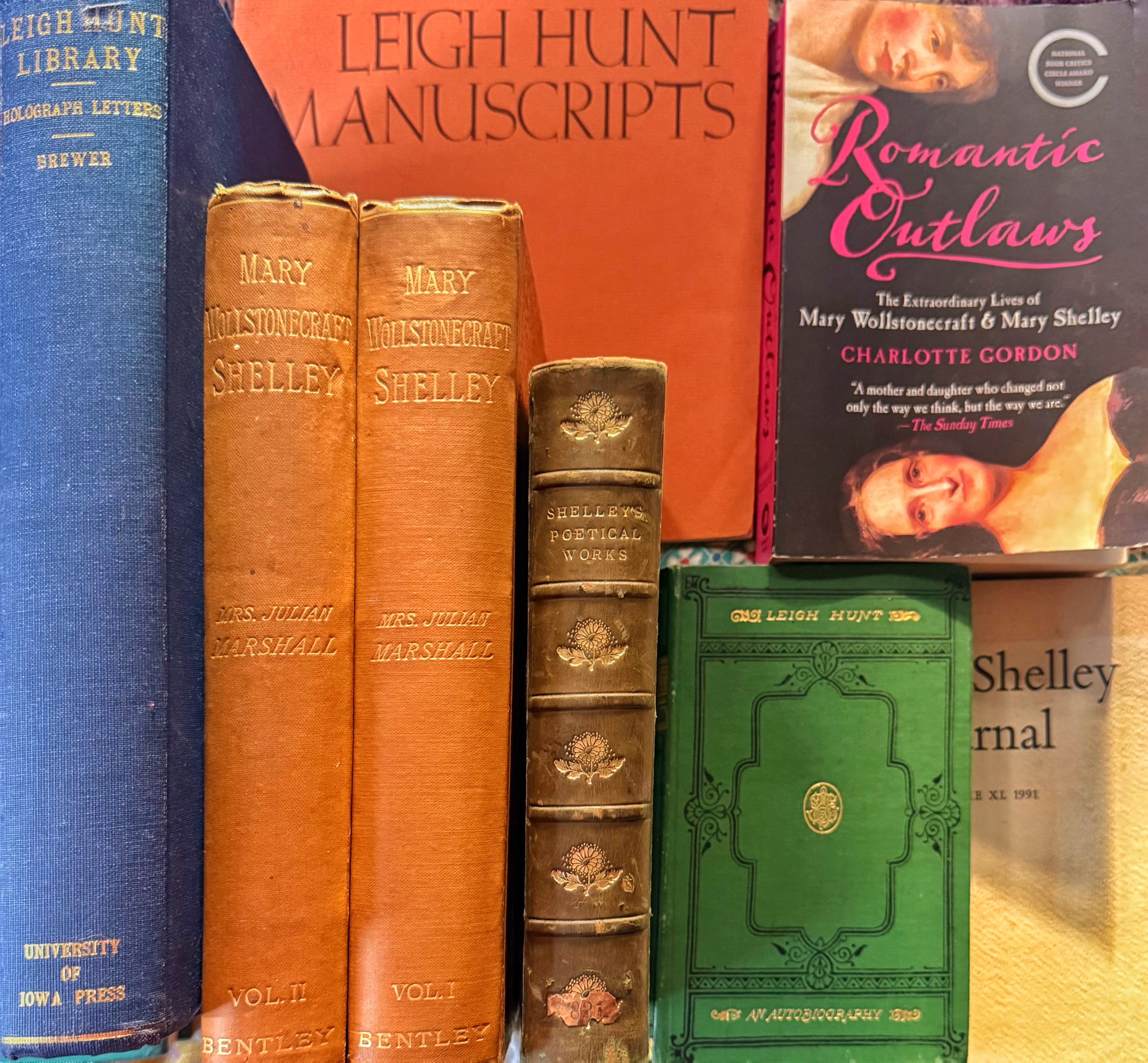
    A logical place to start is with the writer, Leigh Hunt (1784-1859). He was a contemporary of the Shelleys, a close friend, and a faithful recorder. He shared his home with the Shelleys, attended their wedding, travelled with them during their time in Italy, and was with Mary when her husband’s body was washed up on the beach near Viareggio. He also helped her when she embarked on her writing career. 

    I have a collection of Huntiana, and such a collection brings Shelley holdings. I can’t remember what led me down that path, but I wandered down it; unaware that antiquarian booksellers, with a nose for specialist collectors, were lying in wait. Having picked up my scent, they circled like sirens, and before I knew it, a rare Mary Shelley biography sat in my library.

    The Regency romantics were larger-than-life characters, and Hunt’s circle of friends illustrates that: William Hazlitt, Charles Lamb, Lord Byron, John Keats, Percy Bysshe Shelley, Edward Trelawney, William Godwin, Mary Wollstonecraft and Mary Wollstonecraft Shelley (nee Godwin). As Mary Shelley (1797-1851) is the focus of this piece, I will refer to her simply as Mary from here on. 

    Mary’s life was long and eventful, but her teenage years and her relationship with the poet, Percy Shelley, are of particular interest. I possess a few biographies of Mary, but most importantly, a rare first edition, the first authorised biography, ’The Life and Letters of Mary Wollstonecraft Shelley’. Florence Marshall published the two-volume work in 1889 (authorised by the Shelley family). Mary’s descendants had given the biographer full access to the Shelley Archives, and the resulting two volumes remain a starting point for the subsequent Shelley/Frankenstein publishing industry. After reading it again and digging into a few related areas, I was surprised to learn of a connection between my ancestors and Mary; admittedly, a wafer-thin connection, but I’ll take it, anyhow.

    Mary’s father was the radical philosopher William Godwin and her mother, the feminist, Mary Wollstonecraft. Both Godwin and Wollstonecraft possessed impeccable revolutionary credentials. Wollstonecraft was on the barricades during the French Revolution, and wrote ‘A Vindication of the Rights of Women’; her common-law partner, Godwin, was an anarchistic dissenter who wrote about overthrowing the monarchy. Both supported the French Revolution. The couple were at the centre of London’s radical circles at a time when such views were anathema, and consequently, they were despised by so-called ‘decent society’. 

    At first, Wollstonecraft and Godwin lived openly as an unmarried couple, but they married just before Mary was born; neither believed in marriage, but felt the need to legitimise their child. Wollstonecraft already had a daughter, Fanny, when she met Godwin; the result of a previous relationship. Godwin happily treated the child as his own. 

    In her biography, ‘Shelley and his World’, Claire Tomalin wrote;

    ‘The Godwin household was a genuinely extraordinary one. Godwin himself had risen from quite uneducated parents, through the Dissenting academies [Sandemanians], to become the foremost philosopher of his age. In 1797 he married Mary Wollstonecraft, noted for her belief in women’s rights. She had brought back from France a small daughter, Fanny, by an American businessman who had deserted her’

    Tragically, Mary’s mother died of ‘childbed fever’, just 10 days after giving birth to her, and was laid to rest in the graveyard of St Pancras Old Church (her mother’s grave thereafter becoming a place of refuge for Mary).

    Her father, realising that Mary and her half-sister Fanny needed a mother, married Jane Clairmont, who had a daughter of her own, Claire Clairmont. As she grew up, Mary developed a strong dislike of her stepmother, who treated her poorly, and by the time she’d reached her teen years, she had become openly rebellious. Godwin, who had a good relationship with his daughter and valued her active mind, saw how unhappy she was and grew concerned.

    He also observed her fascination for the young poets and radicals who frequented the house, most of whom were adherents of Godwin’s liberal philosophy. Mary was only 14 years old at the time, and her father, sensing her vulnerability, sent her to Dundee to live with a fellow radical dissenter, William Baxter. The year was 1812.

    Baxter and Godwin had both been raised as dissenting radicals, and the Sandemanians, with their close-knit, interlinked congregations in Dundee and London, were part of that milieu. In Godwin’s view, the Sandemanian Baxter family were the epitome of radicalism. As with Mary’s upbringing, the Baxter girls had a degree of freedom, unusual for the time. It was thought an ideal place for Mary to develop her mind.

    The Baxter house, a large rambling one, overlooked the River Tay, and the family treated Mary as a daughter. While there, she became deeply attached to the younger Baxter girls, Isabel and Christy. In that picturesque location, she developed a love of ‘sublime, wild landscapes’, which she later said provided her a backdrop to her ’Frankenstein’ novel. 

    Other factors during those Dundee years shaped her writing, too. The discovery of Gothic novels and later, Isabel’s sudden breach with the family. Isabel fell in love with a scholar and married outside of the sect, resulting in her banishment. Being separated from her confidant and friend distressed Mary, and that sense of alienation also provided source material for the novel. 

    So here is my connection; although a tenuous one, I’ll admit. My third great-grandmother, Sarah Leighton (1787-1868), a contemporary of Mary’s, was also a Sandemanian. Because sect members were forbidden to marry outsiders, the Baxter and the Leighton families were closely connected by marriage – in three separate ways. So William Baxter and his daughters Isabel and Christy were Sarah Leighton’s cousins. 

    By coincidence (or maybe not), my great-grandmother, Alice (Sarah Leighton’s granddaughter), was married in St Pancras Old Church. As a Sandemanian descendant, she was following a tradition of association with the church.

    That made me wonder how this ancient Anglican church was favoured by the sect. Dissenters, both Catholic and Protestant, appear to have been buried there. According to local historians, its isolation was a factor (it was a rural church outside of London proper in Mary’s time). A second factor is evidenced in its history. It is regarded as one of the oldest Christian sites in Europe, dating back to 314 AD, Romano-British (St Pancras was a 14-year-old Roman Martyr). 

    On Mary’s return to London, aged 16 (1814), she fell in love with the poet, Percy Shelley, who felt the same. He was already married to Harriet Westbrook. Godwin, disapproving, believing her too young for an adult relationship and fearing for her reputation, refused to give his blessing (later biographers have accused him of hypocrisy, but I have some sympathy for him, given the laws of the day).

    The couple were bitterly disappointed and met secretly beside Mary Wollstonecraft’s grave. Months later, along with Mary’s half-sister Claire, they fled to France under false names. As a result of the Napoleonic Wars, France was in a sorry state; food was scarce and accommodation substandard. The trio travelled through France, Switzerland and Germany for several months until the money ran out, returning to England where they faced severe social ostracism and mounting debts.

    The next few years were marred by tragedy; Mary and Percy tried to keep a low profile. Mary became pregnant twice during this period, losing her first child (a girl), and giving birth to a son. Adding to the upheaval, Percy Shelley’s first wife, Harriet, drowned herself in the Serpentine, and a disastrous custody court case followed; Shelley was denied custody on moral grounds. The situation did ease somewhat as the couple were finally able to marry. This repaired their relationship with Godwin, and fortuitously, Shelley inherited a small amount of family money. The years of dodging bailiffs had ended. 

    They were also about to travel to Geneva, where the Frankenstein story begins, but the plan to travel there was not of their own making. Unbeknownst to the Shelleys, Mary’s half-sister Claire Clairmont, was having a secret affair with Lord Byron. Without telling the Shelleys, or for that matter Byron, Claire hatched a plan to ambush Byron in Switzerland. Mary was 18 years old. Shelley was about to depart England forever.

    Sources and observations: ‘The Life & Letters of Mary Shelley’ by Florence Marshall; ‘Godwin on Wollstonecraft’ – Godwin, with a preface by Richard Holmes; ‘Shelley & the Unromantics’ – Olwen Campbell; ‘Shelley & his World’ – Claire Tomalin; ‘An Autobiography’ – Leigh Hunt; ‘The Keats-Shelley Journal’; ‘Romantic Outlaws: The Extraordinary Lives of Mary Wollstonecraft and Mary Shelley’ – Charlotte Gordon; ‘The Life & Times of Leigh Hunt’ – Iowa University Hunt Symposium; ‘Shelley’ – A J Symonds. All photographs are the author’s, taken while following Mary’s trail or from his library.  St Pancras Old Church quartered Roundhead troops, served as a burial place for Catholics during the Reformation, and for exiles from the French Revolution. It is now designated as a ‘Chapel of Rest’, in the high-church Anglican tradition. Godwin was also buried there, as was John Polidori (who wrote the first Vampire novel and who is part of Mary’s story). William Godwin’s and Mary Wollstonecraft’s remains were later disinterred and placed alongside Mary’s grave in Bournemouth, leaving Mary’s stepmother Jane to lie alone.

    Part two will look at Frankenstein, Gothic tales spun in Geneva, the Pisan circle, and Shelley’s death in the Gulf of La Spezia. 

  • The Book Eaters

    “Rosenbach records that very young children eat their books, literally devouring their contents, and he gives this as one reason for the scarcity of first editions of Alice in Wonderland”

                          Holbrook Jackson – ‘The Anatomy of Bibliomania’. 

    My library has a collection of books by Umberto Eco, an author, semiotician and one of the world’s foremost authorities on language. His books, whether fiction or non-fiction, examine the historical, political, and cultural forces that have shaped, manipulated, or restricted human communication. 

    In his essay titled ‘Ur-Fascism’, he points out how the Nazis and Fascists used censorship, media manipulation and myth-building to shape their narrative. In a later Eco work, titled ‘This is Not the End of the Book’ (co-authored with Jean-Claude Carrière*), the two men discuss technological threats to the book. Eco argues that the physical book will likely survive the depredations of technology, just as it survived book burnings, censorship and floods, in times past.  

    To illustrate his point, he referenced the CD-ROM (compact disc, read-only memory). Its capacity to store data was so impressive that encyclopaedias were digitised and the printed versions abandoned. There was even speculation that the technology could make physical books redundant. Within a decade and a half, CD-ROM was itself redundant. Anyone wanting to read those interactive encyclopaedias now would need to visit a technology museum. 

     Surviving CD-ROM or e-books is one thing, but surviving AI’s large language models’ appetite for data is quite another. 

    In a recently leaked story, we learned that Anthropic, OpenAI, and others of their ilk have been buying vast quantities of secondhand and antiquarian books, hoovering up the text and then destroying them.  

    In an attempt to conceal this horrendous act of vandalism, the AI companies engaged arms-length intermediaries. Their brief was to scour the second hand and antiquarian bookselling market, posing as private buyers. The books are delivered to clandestine warehouses; truckloads of them. Upon arrival, the books have their backs sliced off by a guillotine, and the disbound pages are conveyed to a copy machine. The books themselves are then trashed by various means. I am tempted to describe it as a ghastly new iteration of the bonfire of the vanities, but the villains here have a different motivation than Girolamo Savonarola. 

    The “why” is not as some might suppose. The AI models are not being fed these old books to increase their knowledge of the past; they are not intending to displace historians or bring a new perspective to classic texts. This is about training the AI models. Anthropic, the worst offender, is in a perpetual race to improve its large language model, Claude; so to achieve that end, it needs ‘clean text’. In AI terms, ‘clean text’ is that found in books printed before 2022. That is the last date that guarantees ‘a pure human-authored baseline’. The project was given the name ‘Panama’, no doubt in reference to the labyrinthine, secretive Panama Papers.

    The AI companies had scraped up every available internet text in no time at all, which gave them unimaginable amounts of data – but with that came a problem. The internet was increasingly filled with AI slop, and that was identified as the main source of AI hallucinations (falsehoods). The irony is that the AI slop was of their own making. They were dogs eating their own vomit. So to avoid that problem, high-quality long-form archives were sought – books printed before 2022 – a ready-made solution.  

    Initially, they intended to purchase the books openly, but then a new problem arose: copyright liability. To avoid paying copyright on that scale, the tech companies sought an exemption from the courts. The courts declined their initial request, but in a subsequent case, a workaround presented itself. Purchasing a physical book and then destroying it straightaway, leaving only the digital text, was deemed to be ‘fair use’.

    As a result, Anthropic decided to scan the texts and destroy the books afterwards. They bulk-purchased books by the pallet and developed Destructive Scanners. These monsters can ingest up to 180 pages a minute. 

    The above practice bears a superficial resemblance to an older destructive practice. After WW2, buying books by the yard became a thing for the first time. When the new money (freshly-knighted supermarket barons) took over the manor houses, they wanted their interiors to look like the interiors of the aristocrats they’d displaced. Agents were employed to buy books by the pallet load – anything with nice spines. The books, though, had to match the colour schemes of the interiors. Book dealers, seeing a way to get rid of unwanted stock, coined the phrase, ‘we sell books by the yard’. This bizarre practice became a running gag among bibliophiles. ‘What a nice collection you have; the spines match your wallpaper perfectly’.

    I will allow Umberto Eco some final words here, as he would have had much to say about the current state of the world. In fact, we don’t need to imagine what he might have said, because his writings are so prescient. * Of his books most relevant to this topic are ‘Faith in Fakes’, ‘The Book of Legendary Lands’, ‘The Mysterious Flame of Queen Loana’, ‘Serendipities: Language & Lunacy’, ‘Travels in Hyperreality’, ‘How to Recognise a Fascist’, and of course, ‘This is Not the End of the Book’. A chapter in the latter is provocatively titled, ‘Our knowledge of the past comes from halfwits, fools and people with a grudge’. 

    And so the Large Language Model AI tech barons may unwittingly be hoovering up ancient-to-modern book slop and falsehoods, believing books past to be a source of unsullied information.

    Carrière: “Do you think that your collections of antiquarian books enable you to enter into some sort of dialogue with the past”?

    Eco: “I only collect books relating to falsities and mistakes, so they are hardly reliable witnesses.”

    Sources and footnotes: Various Umberto Eco publications as indicated; Holbrook Jackson’s ‘Anatomy of Bibliomania ‘; Jean-Claude Carrière wrote the screenplay for the 1962 French/German TV series, The Adventures of Robinson Crusoe; RNZ News printed in the NZ Herald. Eco’s private library was split between two houses, and contained 50,000 books. His Milan library is now open to the public. Book eating is termed bibliophagy.

  • Lost Libraries: Part Two

    Part two of my essay, previously published by Takahē, December 2025

    Part One can be read here

    My descent into biblioclasm

    All ageing book collectors are forced to confront the mortality of their libraries, and the inevitability that most of these libraries will die with them. A private library is an extension of a particular collector’s personality, and, even though the collector’s best books could theoretically survive for a thousand years, the libraries themselves seldom do. Their fate is to give us joy, then quietly vanish. This is how rare books become rare. 

    Some books are more accessible to modern readers than others, and that’s why special collections and private libraries are valuable. They often hold unusual books. They are repositories—seed banks, if you like—telling us who we were, and perhaps who we could be or should not be again. Private libraries are quirky. Each booklover’s library will, over time, have developed a distinct personality of its own. They are places filled with concealed treasures, and each of those treasures itself obscures an untold story—but will those stories ever be told? For the famous, the answer is yes; for the rest, it is unlikely.

    Yet there is nothing that brings on the cold sweats in a bibliophile more than the realisation that their precious library, one that has been amassed over a lifetime, might soon be tipped into a landfill. There are surprisingly few antiquarian booksellers left in my city, and so the rats wait patiently for the day when they can nest in an association copy of a rare first edition. An early Boswell or a private-press treasure makes just as good a nest as a badly written self-help book.

    A friend once told me that he often lay awake at night, the prospect of his collection being disbursed to philistines too much for him to bear, or at least to allow peaceful slumber. I didn’t tell him, but the prospect is worse than that. Many of those beloved books are more than likely to end up in a skip. He was worried that a sharp-eyed antiquarian bookseller would obtain his best books for a pittance and sell them on at a huge profit. My fear is more aligned with reality. That a buyer or an auction house would be shown the collection, select one or two, and declare the rest unsellable. Books should be read. The idea of a book-dealer making a killing at my expense is of little concern, so long as the books are read and loved. 

    But again I return to the idea that value and insight can lie in a particular collection or curation of books as much as in the individual volumes. For this reason, the catalogues detailing writers’ own book collections have always interested me, as their libraries reveal as much about them as their literary output. I have a few such items, including bibliographies, holdings and acquisition records. One of these is Carew Hazlitt’s description of Charles Lamb’s library, complete with bookseller receipts and a record of the books Lamb either lost or gifted. To me, it is a marvellous thing, but who today cares about the painstaking labours of William Hazlitt’s grandson? Who outside of those inhabiting university English departments even knows who Lamb and Hazlitt are?

    The 17th-century collector and first English biographer, John Aubrey FRS, was confronted by what he termed a ‘plaine trueth’ regarding his library. He feared that his manuscripts and books would be lost after his passing, wondering what would become of his ‘pretty things.’ And while he was a modest man, fortunately for us he shared with his less-humble contemporary, Samual Pepys, a taste for gossip. Luckily, the writings of both survived, and the world is glad of it. In Pepys’ case, he feared the opposite: that his often scandalous observations would be read. His scurrilous scribbles were thus carefully encoded, and it took until 1820 for the diaries’ code to be broken—by a vicar based in Baldock, Herts. One wonders what must that vicar have thought when he read the more salacious passages?

    I myself have been the beneficiary of another’s collecting, having many items from Pat Lawlor’s library—signed books, association copies, monographs and ephemera. Lawlor was a journalist, editor, bookseller, writer and noted bibliophile. His name is almost forgotten these days, but he was once a vital part of New Zealand’s literary fabric. Among his friends were the writers Robin Hyde, James K. Baxter, R. A. K. Mason, A. R. D. Fairburn, Eileen Duggan and others. Lawlor had worked as a journalist and editor on numerous publications. Later in his life, during hard times, he operated out of a small office called the Beltane Book Bureau, in the Nathan Building, in Wellington, from where he sold parts of his valuable collection and even model aeroplanes just to keep the wolf from the door. 

    I have a bundle of Lawlor’s papers from that time, neatly bound with white tape, ephemera, print samples and bookplates. I also have books from his library. He was a founding member of PEN (New Zealand), and was partly responsible for getting the Wellington council to protect Katherine Mansfield’s childhood home. It was only after his library had been sold and dispersed that it was realised what an important national treasure had been lost. On the fragments I retain of his marvellous collection, his spidery notes on various endpapers are wonderful; his defacement an enhancement.

    Nicholas Basbanes, in his book A Gentle Madness, referred to the 1980s as the ideal time to collect rare books. Even in New Zealand, it was a high watermark for collectors. I collected during that period, and rare and affordable items could be located if you scanned the market. Basbanes reasoned that it was not until the 1980s that the great Edwardian collections came onto the market. These late Victorian and Edwardian collectors were the stuff of legend; the collectors known as ‘bookmen.’ (Women collected, too, but kept a lower profile.)

    Private collections can be treasure troves. The books in them might not have immediate monetary value, but they hide there, biding their time. Every so often, a delighted researcher will unearth a rarity in an unexpected place, or find a long-lost letter from a literary giant tucked inside granny’s cookbook.

    A librarian in a central public library once confessed to me that many of their significant holdings, those stored in the special stacks, had never been properly examined. When a dealer purchases items from a private library, those books are seldom properly examined either.

    I have a first edition by a once-important author (the aforementioned Dobson) with his handwritten corrections throughout. This had been done so that the printer could make the corrections before the second printing. This carefully annotated copy was passed down for over 100 years; each owner an author, who handed it on to another. Eventually, it ended up in Pat Lawlor’s library. Lawlor in turn gave it to the craft printer Ron Holloway, who gifted it to me. This is both an association copy and one with impeccable provenance. Will it be of interest to someone? Who knows?

    Rarity is created by ignorance and carelessness, although a cunning few have tried to manufacture rarity by hiding or destroying all but a few copies of a work. Capitalising on rarity is also what forgers do. The book world has known a few of those. Those books are collectable, too.

    Ethics, dilemmas and e-books

    Library ‘stacks’ are storage areas where books are stored separately from the shelves the public can readily access. Some libraries grant limited access to their stacks, but generally these areas are accessible only to the librarians. Unofficially, stacks are where books are sent to die. It is an aged-care facility for forgotten print. Private libraries also have stacks (in the guise of cardboard boxes, attics or basements), and I have such a section, one that is shamefully out of control.

    A disciplined collector will catalogue their acquisitions and holdings. A wealthy collector will hire a librarian or an undergraduate to do that for them. For most, though, creating a catalogue is a task seldom completed. The only list of holdings I have is a failed attempt, later appended to a ‘to-do’ list, which in turn was lost in the archives of an old, inoperable computer. 

    It is a fact of life that all modern libraries must discard books. Our National Library is in the process of purging almost everything in its holdings that is not related to New Zealand. There will be an attempt to re-home a few, offer them to overseas libraries, but most are destined for the shredder. I once purchased a handful of gorgeous half-bound leather books that had been purged from the Parliamentary Library, among them an Andrew Lang. 

    Having more books than I could accommodate, I knew the day of reckoning was here; it was time for a serious book purge. I needed a nudge to get started, and the nudge came when family members paid for a nice built-in bookcase. It was not easy sorting the books into ‘keep’ or ‘sell’ piles, but I did so, worried about the burden my children would face if I neglected the task. They live in other countries and have their own collections.

    As I thinned, I loaded quite a few into rubbish sacks and paid a junk collector to take them away. He assured me that he would re-home as many as possible to care homes. Others were just binned — the dismembered and the commonplace. I had become a biblioclast. 

    I had also set aside what I thought were the more saleable discard items. I loaded them into my car and visited a few second-hand and antiquarian booksellers. There are very few remaining in Auckland, and those that remain face the same storage problems I do. One shook his head sadly at the sight of my boxes and rejected most of them. The ‘baby boomers,’ according to him, are the last book-collecting generation. His shop and the containers behind his shop were stacked with boomers’ collections. He had reached his limit. The second buyer I approached was closing down; now, a few months later, both are gone. Two of the premier Wellington buyer/sellers, John Quilter and Rowan Gibbs, have also left the business. All that remains is the drawn-out hassle of selling piecemeal on TradeMe or eBay.

    There are still millions of books being written and sold: the book is not in decline. The problem is not their number, but their distribution and the disruptor technologies (here we must factor in the ubiquitous e-book). The unpalatable truth about e-books and online sales is that they have caused fragmentation, a disjunction between seller and buyer. The pleasure of drifting into an antiquarian bookshop, inhaling the smell of old books and embarking on a voyage of discovery is fast becoming a thing of the past. The serendipitous pleasure of stumbling upon a treasure that you were not looking for has been overridden by Amazon rankings. Bots instruct us what to buy and which online sites stock their ranked recommendations. 

    When you buy an e-book, you get ugly fonts and appalling typography because the lines fall in ways not intended, with the text either squashed or stretched out to fit the allotted text grid. No rivers of prose meandering down the middle of a craft paper page, no wide margins, no texture, no deckled edges. T. E. Lawrence, when publishing Seven Pillars of Wisdom, set up a camp-bed in the printery so he could be there to ensure that the lines fell exactly on the page as they should. I published a physical poetry book, but when an e-book version came out the lines fell in all the wrong places. Poetry lines must flow exactly as intended; it is word breathing, and HTML cannot do that.

    And worse, when you buy an e-book you have only purchased a limited right to read it. It is not yours to give to a friend, and, if you read the fine print, the rights holder (the e-publisher) can remove it from your collection at any time. This harms the second-hand book trade. Why buy an out-of-print book when an e-book beckons? This is a disaster for those selling books like mine, so I will wait for the finer weather and construct a roadside bookstall in the hope that the offer of free books will attract a passerby or two. My last recourse will be a skip.

    A new bookcase and a library of the humanities

    The inevitability of book destruction is a depressing topic, but there is a ready cure. Install and populate an additional bookcase to delay the inevitable. As long as I can remember, I have wanted a floor-to-ceiling, wall-to-wall, white bookcase. Now I have one. It was constructed by Ronnie the builder, a delightful man who measured and ruminated in turns, often singing as he worked. We loved having Ronnie in the house.

    My youthful self had made bookcases using pilfered bricks and planks, and, although they did the job, they rarely rose above waist-height; any higher invited collapse. Later, I purchased a few second-hand bookshelves, the sort designed for people who have no real understanding of book sizes. The shelves were either barely able to accommodate large-format trade paperbacks or designed for large-format encyclopaedias.

    A bespoke bookshelf is a thing of wonder, designed around a collection and able to accommodate the various formats. Some years ago I designed and built a large bookshelf for the living room, where it still has pride of place. My design criteria, though, were focused on aesthetics, not structural integrity, so the shelves are so long that they sag in the middle. They require central support, but that would necessitate de-booking, and so that project, like my cataloguing attempts, is parked on a ‘to-do’ list. 

    The most exciting aspect of acquiring library space is the fun of sorting and populating the new shelves. I have my own method, and so, although I have the deepest respect for the time-honoured system, I intend to take a different route. The first-known librarian, Demetrius, was the head librarian in ancient Alexandria. He preceded Dewey by over 2,000 years, creating a cataloguing system that libraries rely on today. Demetrius and Dewey notwithstanding, I will use my own system. My librarian friends will be dismayed when they read this, which is why I have not sought their advice. Spy-fiction writer, Mick Herron, has similar views which he revealed during a recent New York Times interview. When asked how he organised his books, he quickly replied: ‘How would that work?’ 

    It is a topic that I have often considered, but there is no one right answer. When it comes to book organisation, I am influenced by Jonathan Swift, who wrote ‘The Battle of the Books’ (‎1697), and especially by Gilbert Fabes, who wrote ‘The Autobiography of a Book.’ Both Swift and Fabes have pointed out the dangers in letting incompatible books sit side-by-side. If you subscribe to the view that books are living entities, then their psychological welfare becomes a consideration.

    Mine is a library of the humanities, and almost none of my collection falls outside of that sphere. It is the sort of library that National Party ministers despair at. There are no inspiring books by industrialists, practical guides to wealth creation or books to prepare you for the job market. Instead, it is awash with history books, jazz books, the works of dead philosophers, canonical literature, and poetry. Worse, there are books on books, lots of them. As far as I know, prospective employers never quiz job applicants on the finer points raised in John Carter’s enquiries into 19th-century book forgery.

    My new shelves are bright and cheery, and not the best setting for my antiquarian books. Those are situated on more austere shelves, with the best of them cosseted within a glass-fronted case. I wanted a place for the books I consult often, my overflow poetry, ancient and modern history books, and hard-to-categorise books such as my Buddhist commentaries and sutras. It is an everyday library. I will now hunt for a suitable chair to place beside it, and if I want to research something I will sit there, in a place where books recommend other books. 

    Many of my favourite paperbacks are there, most of the spines looking well-worn. Almost all of the (now tatty) Penguin Modern Poets series, a few scuffed old Dickens hardbacks, none of which look as though they mind sharing shelf-space with shiny new books. I have a Joan Didion section reclining between Umberto Eco and the Beat women poets. They are among friends, and that is what counts. 

    I do have a few broad categories, such as ancient Greece and Rome, or canonical literature, but I bend the rules and never arrange them in alphabetical order within the section. They are not the 801.4 sort of books. Placing Browning close to Baudelaire just feels wrong. Unlike an engineering library, a library of the humanities will never date—unless the rats are given access.

    In this 21st century, I am Eliot’s old man in a dry month, waiting for rain—who knows which of these lovely books will survive the drought? I wrote the poem below a few years ago; later, performing it with a notable jazz musician. It feels fitting to end this essay with it.

    You have to wonder why some words,
    lose their way, can’t find an ear,
    but fall short, while others hang,
    suspended in a spider’s web;
    words set aside, then quite forgotten,
    stuck in an orphanage for lost print,
    dying by degrees in some yellowing stack,
    while expurgating rats move in.
    Musician’s words, though, stay intact
    as pencilled charts inscribed like runes.
    Though the meanings are lost to all
    but the cats, you have to wonder at that.
    And why some words just dance your soul
    while others hit with a dismal clunk.
    They miss their mark, they splutter
    and crash, you have to wonder at that.

    John Fenton, Spring 2025

    Aubrey, John. Lives of Eminent Men: Literary lives (Hesperus Classics).
    Basbanes, Nicholas. A Gentle Madness (Henry Holt).
    Bracciolini, Poggius. Two Renaissance Book Hunters: The letters of Poggius Bracciolini to Nicolaus de Niccolis(trans. Phyllis Goodhart Gordan) (Columbia University Press).
    Burton, Robert. The Anatomy of Melancholy (Chatto & Windus).
    Carelli, Marie. The Marie Carelli Birthday Book (Hutcherson & Co) (my great-grandmother’s copy).
    Carter, John. ABC for Book Collectors (Granada Publishing).
    Dalrymple, William. The Golden Road: How India transformed the world (Bloomsbury).
    de Bury, Richard.The Philobiblon: A treatise on the love of books (Chatto & Windus, miniature facsimile).
    Dobson, Austin. A Bookman’s Budget (Humphrey Milford, Oxford University Press).
    Eliot, T. S. The Collected Works of T.S. Eliot (Faber & Faber).
    Fabes, Gilbert. The Autobiography of a Book (The Elzevier Press).
    Fenton, John. Dancing Between the Notes (Ex Libris Publishing).
    Gosse, Edmund. Gossip in a Library (William Heinemann).
    Hazlitt, W. C. The Lambs: Their lives, their friends, and their correspondence (Elkin Mathews).
    Henri, Adrian, Roger McGough and Brian Patten The Mersey Sound (Penguin Modern Classics).
    Holloway, Kay. Meet me at the Press (Griffin Press); signed by the author and printer.
    Jackson, Holbrook. The Anatomy of Bibliomania (Faber & Faber).
    Lang, Andrew. Adventures Among Books (Longmans, Green & Co.).
    Lang, Andrew (ed.). The Ballad of Books (Longmans, Green & Co.); Parliamentary binding.
    Lawlor, Pat. Confessions of a Journalist (Whitcombe & Tombs).
    Lawrence, T. E. Seven Pillars of Wisdom (Doubleday & Doran).
    Minsky, Jeanette. Sir Aurel Stein: Archaeological explorer (University of Chicago Press).
    Netz, Reviel and William Noel The Archimedes Codex: Revealing the secrets of the world’s greatest palimpsest(Phoenix).
    Shakespeare, William. The Comedies of William Shakespeare—Victorian facsimile of First Folio (authorised by Royal assent).
    Stein, Aurel. The Thousand Buddhas (Project Gutenberg PDF).
    Swift, Jonathan. The Battle of the Books (Chatto & Windus).
    Tylden-Wright, David. John Aubrey: A life (HarperCollins).
    Vallejo, Irene. Papyrus: The invention of books in the ancient world (Knopf).
    Waley, Arthur. A Hundred and Seventy Chinese Poems (Constable & Company).
    Wood, Michael. The Story of China (Simon & Schuster).