‘Illustrators are word people who happen to draw. We work with one foot in a book and the other stuck in a paint pot. Our shoes are a disgrace’ – Wallace Trip.
‘Art is bridging words and images’ -Tony Kushner.
‘Illustrations in picture books are the first paintings most children see’ -Anthony Browne.
Like most book collectors, I have collected certain books just because they featured a favourite illustrator. While the average book purchaser doesn’t spend time considering the quality of the artwork, bindings, typeface, paper (or smell), they can still be unwittingly beguiled by these seemingly peripheral considerations. For me, these alchemical considerations are integral to my enjoyment.
And it’s not always about a new or expensive hardback edition either. An old paperback with an interesting cover can attract me more than an ugly hardback. Aesthetics depend on personal taste and cultural context.
I once purchased a tatty, coverless, 1815 Regency novel for a few dollars. The book had no monetary value at all – so why? Because I wanted to put myself in the original reader’s shoes. As I read, I swear I could detect the musty odour of leather boots and Regency oak panelling. It was a portal into another age.
A book is more than a collection of words; it is the sum of its parts and more besides. If an author decides to illustrate, those illustrations become part of the script. And a book is an unfolding story. An unillustrated first edition might gain illustrations in subsequent editions, and each iteration builds on the earlier narrative.
A reissue of an old text with contemporary illustrations can delight, but to get a fuller picture, we need to see the original too. Serious book collectors know this. If you look back through Charles Dickens’ publications, a rich history of illustrations leads from mid-Victorian to modern times. ’Phiz’, his early illustrator, was fabulous, but many other notable illustrators followed him.
While the publishing industry doesn’t track the ratio of illustrated to plain-text books, it does analyse a few genres. Aside from specialised fantasy editions or chapter-heading thumbnails, modern adult fiction remains nearly 100% plain print (a notable exception, however, is the Japanese ‘Light Novel’, where black-and-white illustrations are standard). Children’s books, by contrast, are 100% illustrated.
The Egyptians, Greeks, and Persians illustrated books by hand, painting images onto papyrus and vellum, but illustrated books were rare. A different print technology emerged in 3rd-century China, using carved woodblocks, but Europe didn’t catch up until the 15th century.
Johannes Gutenberg’s invention of the printing press in 15th-century Germany also popularised the use of paper (the Chinese had been using paper since 105 CE and developed movable type 400 years before Gutenberg). Early printed books, according to several academic studies, were rarely illustrated; even medieval vellum Psalters were only 15% illuminated (I have two medieval ‘Book of Hours’ pages on vellum). In the 200 years following the invention of the printing press, printers still left blank spaces for manual illumination.
Western book illustration as we know it evolved from European woodblock printing and the printing press. Woodblocks could be combined with movable type, since both were forms of relief printing, but the illustrations were often crude. A brief period of metal engraving followed, but the intaglio techniques of etching and engraving soon dominated. These methods remained popular until the 19th century. After that, various new methods and technologies enabled quality colour printing.
In Japan, a colour-printing technique called nishiki-e used many different woodblocks. This produced very high-quality artwork.
The Victorian era is considered to be the ‘golden age of printing’, with its proliferation of technological breakthroughs and mechanised papermaking. And at the same time, literacy rose significantly; printed works were no longer the preserve of the wealthy, but a mass-market commodity.
The Victorian era also saw the rise of the ‘Arts & Crafts’ movement, a rebellion against the Industrial Revolution and new technology. Figures like the socialist William Morris championed a return to handcrafts, and his Kelmscott Press (1891) produced some of the finest books ever printed. He believed that mass-produced books were becoming increasingly shoddy, and he was right.
This gave rise to the Private Press movement, which produced high-quality books that are desirable to modern collectors. I am lucky enough to possess a few, but sadly, no Kelmscott Press. Victorian and early 20th-century private presses included Doves, Ashendene, Vale, Essex House, Eragny, and Cuala. A little later came the Golden Cockerel Press, Nonesuch Press, and Gregynog. Many others are worth collecting too. The illustrations and typography in these finely printed books are frequently exceptional.
Some Illustrators whose works I have collected
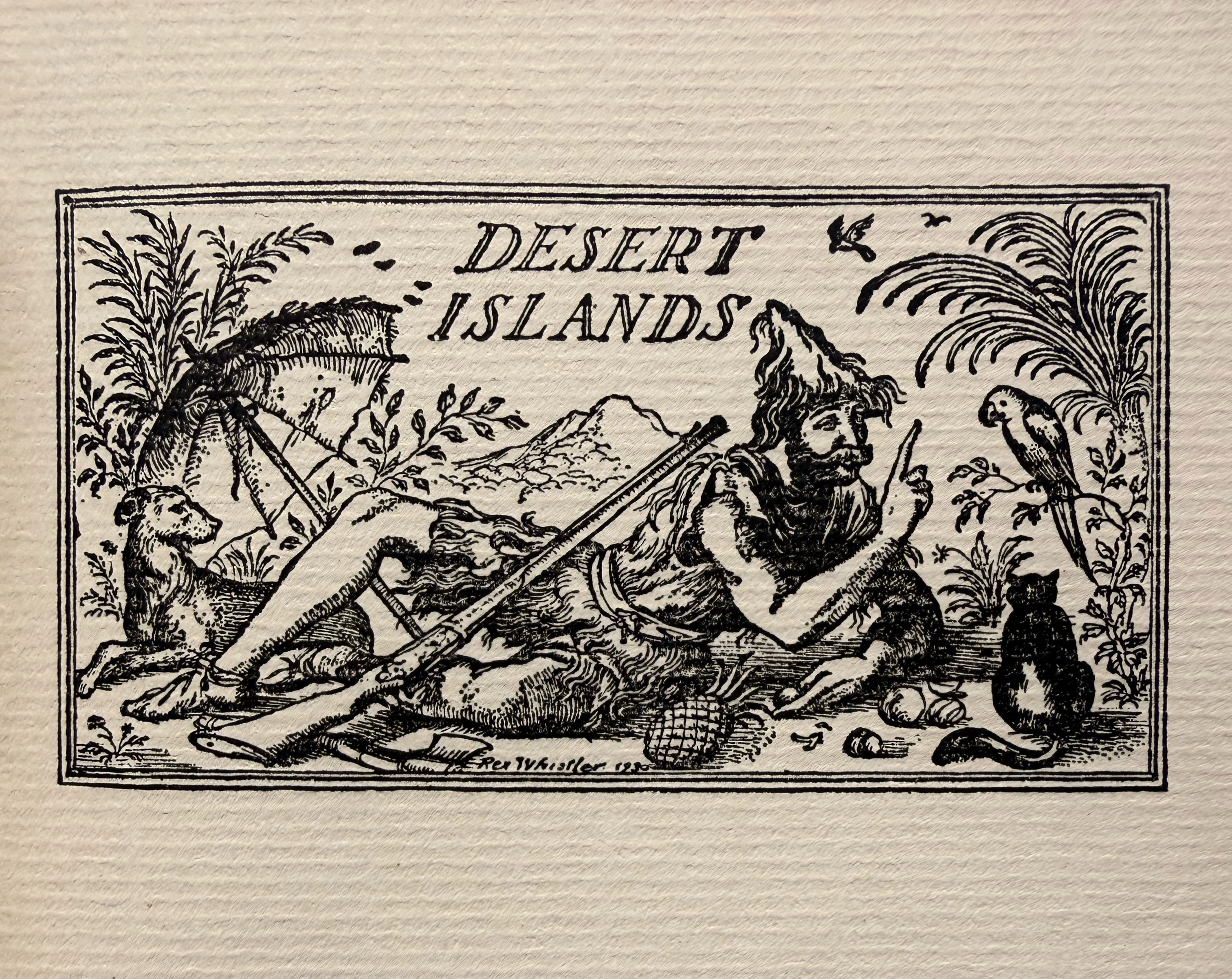
Rex Whistler: A brilliant painter, muralist, illustrator and book designer. His masterpiece is the illustrations for ‘Gulliver’s Travels’ in the Cresset Press (1930). His style was elegant and fine Rococo (ornate but not too busy). He was highly in demand by publishers like Faber and Faber. Sadly, he was among the first to die after the Normandy Landings. I always made a point of grabbing any book featuring his illustrations or dust jacket designs. His brother Lawrence was a famous glass engraver.
– – – – – –
Richard ‘Dicky’ Doyle: A famous Victorian illustrator who started as an errand boy. He designed the original Punch cover and its masthead. He illustrated works by many Victorian authors, including Charles Dickens, William Makepeace Thackeray, John Ruskin, Andrew Lang, and Leigh Hunt. He was fascinated by birds and fairies, and that fascination ran in the family. His brothers were all artists too, and in brother Charles Doyle’s case, the obsession with fairies (and fear of birds) drove him into an asylum. Charles son was Sir Arthur Conan Doyle, who wrote Sherlock Holmes. Arthur also believed in fairies (and spiritualism) and was duped by a photograph of fairies taken by two young girls (they later confessed it was not real).
– – – – – –
Walter Crane: 1845-1915: An anti-authoritarian democratic socialist who illustrated children’s books and adult literature, and designed socialist pamphlets and union periodicals. He was president of the Arts Workers Guild and later the Arts & Crafts Society. He was also Director of Design at the Manchester School of Art and the Royal College of Art. Along with Kate Greenaway and Randolph Caldicot, he set the standard for children’s illustrated literature.
Before Crane and Greenaway, children’s books were mostly morality tales. Although Crane came out of the Arts & Crafts movement, he also studied Japanese and medieval art. Equally important was his apprenticeship as an engraver, which shaped his approach to design and led him to reject its soulless, mechanised processes. Publishers regarded him as a genius, and he was close friends with Oscar Wilde, William Morris, and George Bernard Shaw. He wrote influential books on design, advocating a move away from the then current obsession with filling every available inch of space.
– – – – – –
In an earlier post, I mentioned the Leighton Dynasty of binders, printers and engravers. I am descended from the founder, George Leighton, who printed the ‘London Illustrated News’. The Leightons pioneered a colour-printing technique that soon came to dominate the industry. Another member of that Leighton family, a cousin, was Edmund Blair Leighton, a Pre-Raphaelite painter and Academician. His paintings illustrated books, including George Eliot’s. Several of his illustrations are in the Auckland Art Gallery collection.
– – – – – –
A proper examination of book illustration would require a deeper analysis than I am qualified to deliver. What I have covered here offers a personal perspective and a glance. I may look at the topic again in the future, and if so, comics, children’s books and related areas like book plates could be the focus.
And here in New Zealand, we have a rich tradition of illustration too—the ethnographic art of the explorers (e.g. Buller’s Birds) and the botanical artists. We also have a rich history of cartoons, newspaper illustrations and school journals. And most importantly, the picture book explosion of the mid-20th century, which saw a proliferation of extraordinary children’s books. We have produced many fine engravers, but four wood engravers and etchers stand out: E. Mervyn Taylor, John Buckland Wright, Leo Bensemann and Rona Dyer.
So while I have illustrated books from many eras, my interest focused on a hundred years: mid-Victorian to mid-20th century. It was instinctive and based on my tastes, but there was another reason—the switch from letterpress to offset printing after the 1950s. Economic and logistical factors drove the move to offset lithography: speed, cost, and safety. It’s hard to argue against the change, but something substantial was lost: aesthetics.
Letterpress has been with us in various forms since Gutenberg, but I’m not just talking about nostalgia. When you ink and press text in a galley, something special happens. A crisp, fine impression forms, and in fine printing, you can see and feel it. Letterpress is not a chemical process like offset. We are talking aesthetics, and the finest private press printers have always used and still use letterpress.
When I was a boy, my friends and I collected stamps. They were crisp and typographically beautiful, and the colours were marvellous. After the 1950s, stamp collecting declined, and I blame offset techniques. I had no interest in collecting the ugly objects that proliferated after the 1950s. Thomas De la Rue pioneered stamp letterpress technology and printed stamps for 150 colonies. Rivals like the French Atelier des Timbres-Poste produced iconic stamps like the Sage and Sower series. The stamps of the first 100 years were tiny works of art, but they were replaced by bland, busy ephemera.
And while I have many books with nice modern illustrations, they appeal to me less. I will let the pictures I post illustrate my preference.
Sources referred to and Illustrators pictured: ‘Walter Crane as a Book Illustrator’ by Rodney Engen, ‘Walter Crane, Artist, Designer & Socialist’ by Greg Smith, ‘Line & Form’ by Rex Whistler, ‘The Laughter & the Urn: a life of Rex Whistler’ by Laurence Whistler, ‘Illustrators of the 1800s’ by Forest Reid, ‘The Art of the Printed Book’ by Blumenthal, ‘Millers Collecting Books’ by Catherine Porter. Illustrations, in order from left to right where applicable: ‘Fox & Crane’ – Walter Crane, ‘May Pole’ – Crane, ‘Ali Baba’ – Crane, ‘Gulliver’ (two plates) – Rex Whistler, ‘Desert Islands’ – Rex Whistler, ‘Scarecrow’ – Rex Whistler, ‘A Jar of Honey ‘ Richard Doyle (2), ‘Mr Birchell’s First Visit’ – Thomas Rowlandson, ‘Your Passports’ – 19th-century French, possibly Maris, ‘The Lost God Pan’ – H J Ford, ‘Book of Job’ (two plates) – Herbert Granville Fell, ‘Mosque’ – Frank Brangwyn, ‘Robinson Crusoe’, artist unattributed but I found reference to this 19th-century Warne edition in a Dutch catalogue – almost certainly Ernst Henri Griset. (Dickens) ‘Bleak House’ – Phiz, ‘Mr. Pickwick’ – Phiz, ‘The Old Curiosity Shop’ – C Green. ‘early 1400s Book of Hours illumination’.
‘Capitalism is the astounding belief that the wickedest of men will do the wickedest of things for the greatest good of everyone’, attributed to Maynard Keynes.
‘The day after the revolution, the generals move into the palace’ Anon.
‘The law, in its majestic equality, forbids rich and poor alike to sleep under bridges, to beg in the streets, and to steal each other’s bread’. Anatole France
‘I am a Marxist of the Groucho Variety’. A placard during the May ’68 French youth rebellion
‘Meet the new boss, same as the old boss’. Pete Townshend (‘Won’t Get Fooled Again’)
There is a category of book that always has me searching bedside tables or hunting through the history, philosophy, or biography sections of my library. Even in a public library, these books aren’t always shelved together, and if they are, they’re filed under Nonfiction 300. That section covers social history, including politics, laws, revolutions, and human rights.
According to recent global surveys, reading history books ranks second in preference in almost every country surveyed. In the US, history books represent 30% of books purchased or accessed, and in the UK it’s similar. In New Zealand, it is also our second most popular book genre. Those statistics, however, don’t break the topic down. In the US especially, I suspect most of those history books are about kings, presidents, generals, and military campaigns.
Social history is a subcategory of history based on the lived experience, structures and daily lives of ordinary people. It is sometimes called ‘history from below’ as it examines societal structures and cultural norms rather than examining the lives of ‘great men’. My library is generalist regarding history, but light on military campaigns and generals.
My ‘Dictionary of Social History’ provides the etymology of the word politics. It derives from the Greek word politika, as do polis and police.
A related word, politeia, meaning citizenship or administration, entered English with this meaning: an organised society, civilised society or form of government. Also aligned is dēmokratia, meaning rule by the people.
When considering early experiments in democratic rule, history and philosophy books are the primary sources. Democracy arrived in Greece around the 5th century BCE, but non-Western polities like the Sabhas and Samitis of India had forms of democratic rule long before that (6th-4th century BCE).
No contemporary biographies of the early Greek democrats survive, so much of what we know was written long after they lived. Biography as we know it came about over 400 years later with Plutarch, who lived in the Roman era. Plutarch’s ‘Parallel Lives’ is a fascinating read and still popular today.
To learn about the early struggles for democracy, modern-day historians rely on philosophical works written at the time, broad histories (e.g. Thucydides or Herodotus), or contemporary pamphlets and gossip.
I have many books on the era, but a favourite is ‘The Birth of Classical Europe’, which my parents gave me for Christmas. Also, a book titled ‘The Hemlock Cup: Socrates, Athens & the Search for the Good Life’ by the modern historian Bettany Hughes. She has pieced together a convincing biography, using archaeological breakthroughs, geographical fieldwork and contemporary texts. Bettany Hughes’s approach is sociological.
Revolt
Revolution and revolt, while arising from the same root word, are not exact equivalents. A revolt is usually localised, spontaneous, focused on a specific grievance, and most often brief or temporary. The word comes from the Latin revolvere, to roll back or turn over.
Revolution shares the same Latin root but evolved later out of the noun revolutio, meaning turning a complete circle (turning around completely). A revolution is embarked upon with the intention of bringing about permanent change. Political actions often fall into these two camps.
Revolts have occurred throughout recorded European history.
There were revolts against the Romans by all manner of peoples. In late antiquity, there were revolts against the Byzantine Empire by the Samaritans, Jews and the Slavs – all ethnic underclasses. Later, revolts broke out against the Crusader States and the various European petty-kingdoms.
In medieval times, Flemish peasants and urban workers revolted; later, peasants in northern France (who rose against the nobility); in Italy, wool-carders and labourers struck; and in England, there was the Peasants’ Revolt against the Poll Tax. All were about injustice; many ended badly.
Books on the Great Revolt of 1381 are plentiful. Worth reading are: ‘England Arise: The People, the King and the Great Revolt of 1381’ by Juliet Barker and ‘A Dream of John Ball’ by William Morris (plus any history of Richard II’s reign).
Plague
It is estimated that the Black Death killed nearly half the population of Europe, and as a result, the peasantry found that they had gained bargaining power. Because the plague caused a severe labour shortage, the feudal system weakened, and serfs, realising they could move freely, sought work with the highest bidder.
Revolts invited a counteraction, and four years after this free movement became apparent, the English Parliament passed the Statute of Labourers Act (1351).
The Act froze wages at pre-plague levels and granted feudal lords the right to arrest and brand peasants who left their feudal village. It was not successful because many Lords bent the rules, and those who didn’t soon found themselves short of labour. The 1351 Labourers’ Statute lit the fuse for the Great Uprising (led by Wat Tyler and John Ball).
They won: the Poll Tax was dropped, but the promised broader reforms were reneged on. And despite the leaders being offered an amnesty by King Richard II, Wat Tyler was stabbed during the negotiations and taken to the Tower to be hanged. Poor John Ball, a wandering priest, was hunted down, hanged, drawn and quartered.
– – – – – –
While travelling around the Baltic, I was intrigued by the merchant houses. They are instantly recognisable, and through these impressive, utilitarian dwellings I learned of another revolution that began in medieval times.
A group of private shipping merchants formed a collective to deal with piracy and banditry. The Hanseatic League (Hansa) became so powerful that it cowed the feudal lords of the Baltic. Before the league formed, merchants had no standing because feudal lords recognised only three strict classes: Nobles (who fought), Priests (who prayed), and Peasants (who worked).
The ‘Hansa’ merchants emerged as a powerful and autonomous middle class who broke the ties with those who owned the land. The League, leaderless but united, weaponised its collective bargaining power, forcing rulers to waive feudal privileges; when challenged, they created free ports, raised private navies, and toppled kings.
This was especially evident in Tallinn, Estonia. The town has two ancient walls: a large one around the entire city, built by the merchants to protect them from raiders, and an inner wall, built to protect the feudal lords on the hill from the powerful ‘Hansa’ league below.
The merchants offered former peasants paid employment and trade training, lifting them out of poverty. The merchant houses are interesting because they lack ostentation. They follow a uniform, practical design (regulated by the league): usually three stories high, with a warehouse, staff living quarters, and the merchant families’ quarters. The league had no formal structures or office holders and operated as a loose confederation.
In Tallinn, we visited a medieval church where we saw a mural depicting the Dance Macabre, painted during the Black Death. The mural showed bishops and feudal lords dancing with skeletons. The message was clear. The plague is a leveller, and wealth or privilege won’t protect you.
‘Salt: A World History’ by Mark Kurlansky is an excellent book, and it covers the rise of the Hanseatic League in detail. Also, ‘The Baltic Story’ by Caroline Boggis-Rolfe.
Revolution
Revolutions are mass movements aimed at bringing about regime change or dynastic change and were a feature of English life in Tudor and Stuart times.
The Catholic Queen Mary I, in a mass uprising, overthrew the protestant, Lady Jane Grey (1553), while in 1642 the Puritans, supported by a rising merchant class, overturned dynastic rule, forming the Commonwealth. In both of these revolutions, regime change was achieved, and in both cases, the old regimes were later welcomed back with open arms.
Both revolutions succeeded, but both illustrate a problem that follows a revolution. The old saying about the generals occupying the palace the day after the revolution is apt. Utopian dreams can easily turn into nightmares, and freedoms won can be just as easily lost. One yoke can be exchanged for another.
After a revolution, chaos often follows, and pathways open up: democracy, more chaos, or authoritarianism. The justification for bringing in authoritarian rule after a political upheaval usually follows a standard script. This is necessary to protect you from the enemy within and without. What begins with lofty ideals and enthusiastic support can quickly turn nasty.
Among Peter Ackroyd’s series of books on the history of England is volume IV, ‘Revolution’. This volume covers the period from William of Orange’s arrival to the defeat of Napoleon at Waterloo.
At the beginning of William and Mary’s reign, a bloodless revolution took place. A group of aristocrats and gentry, acting in their own best interests, drafted a declaration later known as the Bill of Rights. That document ended the divine right of kings, and the power to enact laws and levy taxes shifted to Parliament. It was known as the ‘Glorious Revolution ’, and by removing power from the king, the aristocracy had placed it firmly in their own hands.
While the French Revolution caused violent upheaval, the English, mindful of the earlier English Civil War, underwent a period of incremental and largely peaceful revolutions. By the end of the Georgian era, we have the writings of Mary Wollstonecraft, Thomas Paine, William Wilberforce, Thomas Spence and the Regency Radicals.
Essential reading on the development of political theory is Jean-Jacques Rousseau’s ‘The Social Contract’. It introduces the revolutionary idea that everyone’s voice should be heard when formulating a nation’s policies, and that elected officials have a social contract with all citizens.
‘The social pact, far from destroying natural equality, substitutes, on the contrary, a moral and lawful equality for whatever physical inequality that nature may have imposed on mankind; so that however unequal in strength and intelligence, men become equal by covenant and by right’ – Rousseau
Industrial Unrest, the Abolitionist Movement and Economic Radicalism
Because of the ill effects of the Industrial Revolution, such as the displacement of agricultural workers, the rise of city slums, child labour and appalling working conditions, a revolutionary movement led by labouring workers and artisans emerged.
Led by weavers, the Luddites broke into factories and destroyed automated looms, while in rural areas agricultural workers smashed threshing machines. Amid growing anger over rising child labour, low wages, and unsafe working conditions, trade unions emerged.
Medieval trade guilds had set a model, formed during the great age of cathedral building. Realising their power, the guilds pioneered collective bargaining and threatened to withdraw labour to secure better conditions.
During this period of unrest, two significant protests captured the public imagination. After these events, the ruling parties and the industrialists found it impossible to retain the status quo.
The first was the ‘Peterloo Massacre’, which occurred on the 16th August 1819. On that day, a peaceful crowd, estimated as being between 60,000-100,000 working-class demonstrators, met to demand parliamentary reform, universal suffrage and relief from poverty.
A local magistrate, alarmed, ordered the 15th Hussars to disperse the crowd with disastrous results. Although it was a peaceful assembly, a sabre charge was ordered, killing 18 people and injuring up to 700 others. The government’s initial response was to crack down, but a public outcry led to a decade of reform.
I met Murder on the way –
He had a mask like Castlereagh –
Very smooth he looked, yet grim;
Seven blood-hounds followed him:
Percy Bysshe Shelley (The Mask of Anarchy)
The second was a farm workers’ protest in 1834, when 6 men were arrested for forming an agricultural workers’ union by swearing an oath. They were led by a Methodist preacher, George Loveless and their grievance was centred on an employer’s legal right to lower a worker’s wages unilaterally.
These men are now referred to as the Tolpuddle Martyrs. For protesting and swearing an oath, they were sentenced to seven years’ hard labour and transported to Australia.
A public outcry and demonstrations followed, with an 800,000-signature petition being sent to Parliament. Under intense public pressure, the government caved, pardoned the men, and returned them to England.
During this period, land reform and the abolition of slavery occurred too. The Reform Act of 1832 changed the electoral landscape forever by abolishing 56 rotten boroughs (electorates bought and sold by the wealthy). Some rotten boroughs were tiny plots of land, while industrial cities like Manchester and Birmingham had no representation.
Once these seats were redistributed, the voting population increased by 50%, and the anti-slavery urban middle class gained a voice. The new voters demanded the abolition of slavery, and it was outlawed soon after that.
I wonder if those who fail to exercise their right to vote today realise how hard-won this privilege was.
Karl Marx, the Fabian Socialists and World War 1
During the Victorian era, the underclass gained greater political awareness, and several influential political theorists emerged. Karl Marx was foremost among them: his most famous work, Das Kapital, fuelled revolutions and liberation movements.
Marxist theory is still widely debated today, and even those on the right reluctantly accept some of his insights (that capitalism features boom-and-bust cycles and has the unprecedented capacity to accelerate technology and concentrate wealth). Those last points are extremely relevant today, as a billionaire class, with its pet technologies, hurtles us toward danger.
Marx’s core ideas were: (1) that material conditions and economic activity, not religion, shaped history, (2) that society is divided into the owners of production and wage workers, (3) that profit comes from paying a worker less than the actual value of the goods they produce. Marx also observed that workers could withhold their labour; however, he saw this as a temporary step toward abolishing the wage-labour system entirely.
Collective bargaining, as used by the modern trade union movement, is based on the right to withhold labour. However, it is not Marxist, as it aims to bring about fairness and social justice, while still operating within the capitalist system.
Other socialist thinkers wrote during the Victorian era, including John Ruskin, William Morris, and Charles Kingsley, along with his Christian socialists. Kingsley wrote, bitingly:
‘We have used the Bible as if it were a constable’s handbook – an opium dose for keeping beasts of burden patient, while we overload them’.
A little later came the Fabians. Their leading lights were George Bernard Shaw, Beatrice and Sidney Webb, Annie Besant, Eleanor Marx and Beatrix Potter. The Fabians believed that capitalism should be reformed step by step, incrementally transforming society until socialism was achieved. This put them at odds with the revolutionary socialists like Vladimir Lenin.
The Fabians believed the state and municipalities should control all essential utilities (gas, sewage, water, electricity, public transport networks). Their aim was a state-planned economy that worked for the greater public good. This laid the groundwork for the first Labour government, which went even further.
The Fabians may have helped shape policy, but the UK Trade Union Congress (TUC) created the UK Labour Party. At the 1889 congress, delegates voted to establish a political body better able to secure working-class representation.
In 1906, the Labour Representation Committee (LRC) officially renamed itself the Labour Party.
The late 19th and early 20th century also saw the rise of women’s suffrage militancy.
In the years preceding the Great War, over 3,000 strikes occurred in Britain, and this newfound militancy was spreading elsewhere, too. Confrontations between labour and the establishment surged worldwide.
In Russia, a feudal empire fell, while in Canada, Australia and New Zealand, heated confrontations were occurring. Working people were no longer prepared to live in abject poverty while the ‘robber barons’ grew fat off their labour. That period in Britain became known as ‘The Great Unrest’.
Just as they were gaining traction, World War 1 intervened. The labour movement’s push to create the first British Welfare State stalled; greater equality and a national health system would have to wait.
While strikes were outlawed during the Great War, the appalling way that the soldiers were treated further radicalised them.
Influential writers like George Orwell, H G Wells, Upton Sinclair, Bertrand Russell, Laurie Lee, and John Steinbeck advocated class solidarity and promoted socialist democracy.
The Quest For Security and The New Zealand Labour Movement.
The New Zealand Labour movement shares its DNA with the UK Labour Movement. It got off to an early start in 1840, when a carpenter named Samuel Parnell insisted on a 40-hour week.
As the colony grew, so did trade unions, working men’s organisations and suffrage groups.
Exploitation was rife, and New Zealand workers, often hardened by their experiences in their home counties, were in no mood to suffer in silence. Nowhere was this more apparent than in the mining sector.
In 1908, New Zealand lost its short-lived reputation as being ‘a land without strikes’. This occurred when 7 Blackball miners, led by Paddy Webb and Pat Hickey, took longer than 15 minutes to eat their lunch. Meal breaks were called ‘crib time ’, and the mine owners resented them. It was time away from digging coal, and that was all they cared about. For exceeding their 15-minute meal break, they were fired on the spot.
This led to an all-out strike, the union demanding reinstatement and a 30-minute lunch break. The case went to compulsory arbitration, where the firing was upheld. The union was then fined £75, which the men refused to pay, and so their assets were seized and put up for auction.
The auction was a farce because local solidarity meant that only a few pennies were raised.
The conditions at the mine were appalling, too: silicosis was rife, the equipment was makeshift, and the housing was substandard.
Because the men held firm, the company soon capitulated, giving their jobs back, abandoning a proposal to extend the working day and no longer docking them for the time it took them to be lowered into the pit.
One miner, Pat Hickey, went on to become secretary of the ‘Red Feds’ (The Federation of Labour), another, Bob Semple, became a senior minister in the first Labour Government, and Paddy Webb became the editor of the influential ‘Maoriland Worker’ newspaper. The New Zealand Labour Party began in Blackball.
The ‘Maoriland Worker’ was founded in 1910 by the Christchurch Shearers Union and it later became ‘The New Zealand Worker’ and subsequently ‘The Standard’. It was a quality publication and, at one point, had a circulation of 10,000.
The paper, though, struggled to meet libel costs and faced police harassment during World War 1. In 1922, the paper was charged with ‘blasphemous libel’ for publishing a poem by Siegfried Sassoon. This was the only time such a charge has been laid in New Zealand.
Other pivotal events leading to the formation of the NZ Labour Party were the Waihi miners’ strike (1912) and the waterfront strike (1913). The waterfront strike involved 16,000 workers, and so the conservative Prime Minister, William Massey, sent in the navy and a large number of volunteer ‘special constables’ (Massey’s Cossacks). After that, the union decided that the New Zealand Labour Party should contest the next election.
Before this period, many working people had moved to New Zealand, seeking a better life. This is what brought Paddy Webb to New Zealand. He forged his militancy on Australia’s goldfields, alongside fellow miner Micky Savage (Michael Joseph Savage).
Savage grew up in the Victorian countryside, where poverty had forced him to become a swagger. He eventually worked on the alluvial goldfields, where he met Webb, who later suggested he come to New Zealand. He arrived in 1907, working as a labourer and organising for the unions, until entering parliament in 1919.
He became the party leader in 1933 and, in 1935, became New Zealand’s first Labour Prime Minister.
His achievements and those of his successor Peter Fraser were significant: fairer industrial legislation, a statutory minimum wage, the 40-hour week, 8 public holidays, free secondary education up to age 19, the country library service, the Fair Rent Act, the unemployment benefit, the Public Works Act, extending the pension system and universal free healthcare through the Social Security Act.
The provision for universal healthcare initially included GPs, but pushback from the British Medical Association led to a compromise. “From the cradle to the grave” was the defining slogan of the first Labour Government’s welfare system. The premise was simple: everyone was entitled to a decent standard of living.
The Labour government guided and hastened NZ out of the Great Depression by reversing wage cuts, spreading wealth, building state houses, improving infrastructure, and cancelling austerity measures.
Among the best social histories of Colonial and Post-Colonial New Zealand are the works of Michael King, Claudia Orange, James Belich, Ranganui Walker, and Vincent O’Malley. Patricia Grimshaw’s history of the women’s suffrage and temperance movements in New Zealand is also important reading. New Zealand was the first in the world to achieve universal suffrage.
While the above struggles were occurring, and largely unnoticed, a harsh poll tax was imposed on the Chinese. In 1860, gold miners were enfranchised, and Māori men obtained the vote in 1867.
– – – – – –
My partner Darien’s family is part of this story. Her grandfather, Fred Frost, a coal miner from Sunderland, came to New Zealand in 1911 and found work at the Millerton mine (Buller). He was a union man and was involved in the struggles which raged along the West Coast.
A few years later, along with other New Zealand miners, he was sent to Arras with the sappers during WW1.
The commander of his Tunnelling Company later complained. ‘I had 17 ex-secretaries of Labour Unions in the unit, as well as members of the ‘Red’ Federation of Labour’. Her grandfather Fred was later elected to Parliament with Michael Joseph Savage in that first Labour Government (1938). During his fiery maiden speech, he spoke about his commitment to socialism.
On the other side of Darien’s family was a famous Irish rebel. She is a direct descendant of Charles O’Brien, one of two men who were hanged at Youghal Gate in 1798, County Cork. He was hanged for being a member of the forbidden United Irish Party. Darien, a staunch unionist too, went on to become a Labour member of parliament, like her grandfather.
My point of connection is modest by comparison. I was a regional organiser for the New Zealand Workers Union, the same union that Micky Savage had belonged to in Australia and New Zealand. Like Savage, I organised shearers and rural workers. At one time it was among the largest of New Zealand Unions, but it eventually came to a sad end.
When in Wellington doing wage negotiations, I would marvel at the old Standard Press, still located in the union building. The famous workers’ newspaper ‘The Standard ‘; the voice of the Red Feds and the Labour Party; the newspaper with its origins in the Flax Workers and Shearers union; and most importantly, the ‘Maoriland Worker’. I love printing presses, and this one was special.
The Social History of the Twentieth Century
Anyone interested in social histories will find rich pickings in books written about the twentieth century. It is far enough behind us to be properly evaluated, but close enough to be put under a critical microscope.
Tony Judt’s writings are an excellent place to start. His book ‘Postwar’ brought him international fame, but his clear-eyed examination of the state of Israel also brought him controversy. He was born to secular Jewish Parents, but became disenchanted with Israel after the Six-Day War.
A Public intellectual, socialist democrat, and a harsh critic of Reagan’s neoliberalism and Thatcher, but also someone who held the left to account. Other works of his are ‘Ill Fares the Land’, ‘Reappraisals: Reflections on the Forgotten Twentieth Century’, ‘Thinking the Twentieth Century’.
Another social history worth reading is ‘Lives Between the Lines’ by Michael Vatikiotis. It covers the fading years of the Ottoman Empire and the diverse ethnicities that thrived there. In a similar vein is ‘A Peace to End All Peace’, by David Fromkin, about the carve-up of the Ottoman Empire and the consequences, still playing out today.
‘1956: The World in Revolt’ by Simon Hall is fascinating, as he gives a snapshot of a turbulent year in post-war Europe and America. It was a year of the Bread Rebellion in Poznan (Poland), the Hungarian Uprising, Mandela’s Long March, Martin Luther King and the Montgomery bus boycott, the Cuban Uprising, the Algerian War of Independence, the Cypriot Insurgency, and the Suez Crisis.
Lastly, and not least, is the youth counterculture revolution of the 1960s. The movement began earlier with the ‘Beats’, and while the so-called ‘summer of love’ got the media’s attention, broader forces were at work. Youthful feminists, environmental activists and anti-war activists militated for change, and the reverberations circled the world.
Baffled parents watched their children dropping out – questioning the technocracy and conservative values – challenging racism, orthodox religion and the corporate industrial society.
In May 1968, a student and labour uprising in France brought the country to its knees. It began on the campuses and was followed by a general strike involving 10 million workers. Charles de Gaulle temporarily fled Paris, but the strike ended after generous wage settlements were offered and accepted.
The last strikers to leave the barricades in 1968 were the schoolchildren (their modern counterparts have just occupied the barricades again).
Many books and essays capture this movement, but a favourite of mine is ‘The Making of a Counterculture’ by Theodore Roszak. Many regard the counterculture revolution as a failure, but was it?
This post draws on my own reading habits, so the threads reflect my tastes and biases. Others will make different connections, but the point of reading history is to understand how we got here, and hopefully, to absorb history’s lessons.
To fully understand fascism or the forces of neoliberalism, we need historical context. We live in perilous times, and understanding the arc of history has never been more important.
Note: I have not included India or the Far East; I will post about them separately.
Sources: The Wordsworth Dictionary of British Social History, The Story of Philosophy by Bryan Magee, ‘Plutarch’s Lives’ – unabridged, ‘The Histories’ by Herodotus, ‘The Birth of Classical Europe’, by Price & Thonemann, ‘The Hemlock Cup: Socrates, Athens & the Search for the Good Life’ by Bettany Hughes, ‘England Arise: the People, the King & the Great Revolt of 1381’ by Juliet Barker, ‘A Dream of John Ball’ by William Morris, ‘Salt’ by Mark Kurlansky, ‘The Baltic Story’ by Caroline Boggis-Rolfe, ‘Elizabeth 1’ by Anne Somerset, ‘Cavaliers & Roundheads’ by Christopher Hibbert, ‘Revolution: The History of England vol IV’ by Peter Ackroyd, ‘A Vindication of the Rights of Women’ by Mary Wollstonecraft, ‘The Rights of Man’ by Tom Paine, ‘The Social Contract’ by Jean-Jacques Rousseau, ‘The Mask of Anarchy’ by Percy Shelley, ‘Das Kapital’ by Karl Marx, ‘Unto this Last’ John Ruskin, ‘The Christian Socialist’ Charles Kingsley, ‘The First Fabians’ Norman & Jeanne MacKenzie, ‘The Road to Wigan Pier’ George Orwell, ‘Animal Farm’ George Orwell, ‘As I Walked Out One Midsummer Morning’ by Laurie Lee, ‘The Red & the Gold’ by Stanley Roche (Waihi Miners Strike), ‘Tatau Tatau: One Big Union All Together: the Shearers & the Early Years of the New Zealand Workers’ Union’ by John E Martin. ‘From the Cradle to the Grave’ by Barry Gustafson, ‘New Zealand Labour Party’ by Peter Franks & Jim McAloon, ‘Tomorrow Comes the Song: a life of Peter Fraser’ by Michael Bassett & Michael King, ‘The Quest for Security in New Zealand:1840 to 1966’ by Dr Bill Such, ‘Women’s Suffrage in New Zealand’ by Patricia Grimshaw, ‘Bread & Roses’ by Sonja Davies, ‘Thinking the Twentieth Century’ by Tony Judt, ‘Ill Fares the Land’ by Tony Judt, ‘Postwar’ by Tony Judt, ‘Lives Between the Lines: A Journey in Search of the Lost Levant’ by Michael Vatikiotis, ‘A Peace to end all Peace’ by David Fromkin, ‘1956: The World in revolt’ by Simon Hall, ‘The Making of a Counterculture’ byTheodore Roszak, ‘Jumping Sundays’ by Nick Bolinger’—photographs: The Danse Macabre, Tallinn; Hansa houses, Tallinn.
“If a tree falls in the forest, other trees are listening.” Peter Wohlleben (forest scientist)
“An economist without knowledge of nature is therefore like a physicist without knowledge of mathematics.” — Carl Linnaeus (1707-1778)
“‘What lies over there?’ said Mole, waving a paw towards a wood . . . ‘Oh, that’s just the Wild Wood,’ said the rat shortly. ‘We don’t go there very much‘. – The Wind in the Willows – Kenneth Grahame
Certain shelves in my library are devoted to botany, and many of the books I inherited from family. Despite my attempts to curb the impulse, others join them every year. Some, the ones leaning heavily on the finer points of classification, are dry and scholarly, while others, the cheerfully illustrated ones, preen like peacocks. Both have their place in my library.
These particular books are jumbled together as they’re in constant rotation. They are in no fixed order; they spill onto shelves they don’t belong in, while the remainder, the attention grabbers, lie on coffee tables. I like them all, but my favourite botanical books are those dedicated to the history of gardens and to the influence of the plant hunters. Their work changed our diets, brought new aesthetics to our gardens, and laid the groundwork for the colonist plundering that followed.
Books about the history of oceanic exploration are inevitably books about colonisation, as the discovery of new territory by men in breeches was always followed by rampant exploitation (and the spread of disease). Frequently, the West’s gain was the East’s or the South’s loss.
After Vasco da Gama’s circumnavigation, the spice trade became the focus for European mercantile explorers, and what followed could be described as the first world war. A trade established through dirty deals and gunboat diplomacy eventually led to exploitation and colonisation. This led to wars over the Spice Islands between European superpowers: Dutch, British, Spanish and Portuguese.
In the 17th century, the Dutch traded Manhattan to the British for a tiny spice Island called Run. Run Island in the Banda Island group (Indonesia) was covered in nutmeg trees (Myristica fragrans), which were worth more than their weight in gold.
Joseph Conrad’s first novel, Almayer’s Folly (1895), outlines friction between European Far Eastern colonists and the negative effect they had on the indigenous Malayans. His most famous work, The Heart of Darkness, deals with the exploitation of the Belgian Congo, and while the book details the evils of the ivory trade, similar exploitation of the rubber tree was occurring too.
No two plants symbolised the greed of this trade more than the opium poppy (Papaver somniferum) and the tea plant (Camellia Sinensis). Tea became an English obsession in the 18th century, and by the 19th century a trade imbalance had arisen; British ships then smuggled opium into China and demanded silver in return. What was seen by the British as a solution to a financial problem resulted in the opium wars.
The ships that penetrated the Far East also returned with new aesthetics in garden design. As the Westward-bound Moors introduced water fountains, desert palms, oranges and exotic garden designs to Spain, so explorers returning from the East brought home exciting new plants and garden concepts.
Foremost among these aesthetic influences was naturalism, which replaced geometric formalism – a movement that had also come from the East (Persia).
An 18th-century landscape architect and plantsman, nicknamed Capability Brown, led that naturalism revolution in England.
This placed concepts like ‘borrowed scenery’ at the heart of garden design; an idea taken from Chinese and Japanese gardens. The discipline required hiding boundary fences to obscure a neighbour’s dwelling, or making a distant mountain or a distant copse of trees look as if they were part of your garden. The basic elements: visual extension (borrowing), intentional framing (using trees, gateways or windows to frame a view), foreground connection (using rocks and small mounds to mirror distant hills and mountains), and screening (hiding unwanted views or objects).
Another eastern development was Garden Chinoiserie: a hybrid form that Brown found annoying. The fad for assembling mock pagodas and tea houses, which, in his opinion, was a step too far.
When the aristocrats embraced naturalism, many took it to extremes, removing entire villages if they spoiled a view, or if they wanted an artificial lake. A few even painted their cows to get the right aesthetic effect.
Anyone who has visited the gardens that the Moors created in Sicily or Spain will understand why they are UNESCO World Heritage sites. The Alhambra and the adjacent Generalife especially. The same goes for the Royal Botanic Gardens at Kew, in London and the Jardin des Plantes in Paris (the latter is a National Heritage site).
All of these botanical gardens are natural history museums. They evolved out of conquest and exploration. I have visited and lingered in these gardens, and foolishly, I have often purchased heavy books to lug around in my backpack. If I had been a Victorian plant hunter, I’d have visited with camels, horses or donkeys in tow (and maybe a bearer or two).
Both Kew and the Jardin des Plantes were formed to accommodate, study and display the plants the botanical voyagers returned with.
Learning trees
Boys seldom admit an interest in plants, but it happens when immersed in nature. From a young age I was taken into forests and gardens, and found contentment there. My father had a keen interest in botany as did my mother, and both were introduced to the world of plants by their parents.
When my grandfather and I walked a bush track near his house, he would pause, cover my eyes, and ask me to name the trees we’d passed. From this I learned to be observant, and my tree memory-library grew. Once curiosity about nature has been aroused, the desire to know more follows. I know most of the native and exotic trees in my area, and if I find one that I don’t recognise, I don’t rest until I can name it.
Naming trees and plants is the first step in understanding the natural world. As humanity becomes increasingly disconnected from the plant kingdom, we fail to heed nature’s warnings. A survey in the USA found that most young city dwellers could identify only two tree species: pines and ‘the other ones’.
I have an early memory of my father reading me a book titled ‘Nat The Naturalist’ by George Manville Fenn (published 1883). It was his favourite when young, along with the Reverend Gilbert White’s ‘The Natural History of Selborne’. I have my dad’s copy of White’s book. It is a handsome 1907 edition, printed by Macmillan & Co and illustrated by P. H. Delamotte.
The Natural History of Selborne is a treasure of English literature. First published in 1789, it has never been out of print. It’s regarded as a foundational text for ecology. White’s observations are so detailed and precise that today’s climate modellers use them as a benchmark when measuring seasonal variations. It is more than a book of natural history; it is literature, and among the finest of its kind.
My dad was a naturalist like White, and like him, he kept a diary of bird and plant observations. He was one of three ornithologists who rediscovered the Kokako, 70 years after it was thought extinct. And being a reverend himself, I suspect my dad saw himself as walking in White’s shadow.
The term naturalist has fallen out of favour these days, probably because it sounds too much like a similar term: naturist. Naturists are birds of a different feather (actually they are featherless).
Early Botanical books
In India, somewhere between 1500-1000 BCE, a dedicated botanical dictionary attributed to Parashara appeared. Around 300 BCE, the Erya, a dictionary categorising plants, circulated in China; 600 years later, the Nanfang Caomu Zhuang, a botanical dictionary by Ji Han, described the plants of the wider Southeast Asian region. Chinese plants were categorised by appearance, habitat and usefulness.
Around the same time that the Erya was being compiled, the ancient Greek writer Theophrastus wrote the foundational botanical work, the Historia Plantarum; Herodotus noted his observations of the natural world; and circa 377 CE, the Roman botanist Pliny the Elder wrote the Naturalis Historia.
I like reading about pioneer naturalists and especially the fairly obscure ones. Most New Zealanders educated in the 20th century (and I suspect in other English-speaking countries) received an Anglocentric education. They taught us about explorers like Cook, Drake, Livingstone, and perhaps Marco Polo or Vasco Da Gama, but never about Polynesian navigators; they also omitted Xuanzang, Ibn Battuta, and Admiral Zheng He.
The circumnavigations and explorations spurred botanists to seek, describe and classify exotic flora as never before. Europeans especially saw themselves as plant discoverers. Indigenous peoples, however, already possessed vast amounts of botanical knowledge. Few of the explorers took advantage of this.
Ibn Battuta (1304-1369) set out from Morocco and travelled on foot through Africa and Asia. Later, when he published his diary, it was filled with descriptions of plants, animals and local customs, much as Herodotus had done in the 5th century BC. Around the same time, Arab botanists and travellers, like Ibn al-Batar, Rashid al-Din al-Suri and Ibn Bassal, compiled thorough botanical dictionaries.
The Plant Collectors
Botanists like Joseph Banks were highly skilled, and no doubt interested in plants for their own sake, but the funders of these explorations were primarily interested in extraction and utility. The collectors prepared the plants for transit (or put them in a Wardian Dry Case) and sent them back to Europe. The instruction was nearly always: find something we can exploit.
Cook reported on huge stands of Kahikatea during his New Zealand voyages, believing they would be perfect for ship masts. Unable to obtain Baltic pine during the Napoleonic Wars, the British Admiralty sent ships to New Zealand to fell and ship the Kahikatea logs home. They rotted quickly once they were dried and proved useless.
The Hauraki Plains near Thames bear the scars of this depredation. A few years later, Kauri tree felling gained such momentum that only a few stands of adult trees remained.
The southernmost tree in the world is at the bottom of Patagonia; the species is Magellan’s Beech (Nothofagus Betuloides). Banks and Cook named this tree during their southern ocean expeditions. The name honoured the Portuguese circumnavigator, Ferdinand Magellan (who unfortunately died just short of his goal; his crew members completed the journey).
The French also undertook botanical surveys; one of the most interesting was Jean-François de Galaup, Comte de Lapérouse. He arrived in Botany Bay eight days after Governor Arthur Phillip. If he’d arrived eight days earlier, Australia might have been a French colony.
After the Frenchman’s ships left Sydney, they vanished. King Louis XVI sent a rescue mission commanded by Rear Admiral Bruni d’Entrecasteaux. On that voyage were two botanists (one of whom was a stowaway, a woman disguised as a man, as women were forbidden on French warships).
The principal botanist, Jacques-Julien Houtou de Labillardière, a former student of Joseph Banks, fell seriously ill; consequently, his assistant botanist had to classify the plants en route. The assistant’s real name was Marie-Louise Girardin, but she had enlisted as Louis Girardin. She died of dysentery near the end of the voyage, and it was only then that her true gender was revealed.
On his way to the Guillotine 5 years later, Louis XVI asked his executioners, ‘Is there news of La Pérouse? ’
Another female French botanist, Jeanne Baret, had circumnavigated the globe in 1766. Also disguised as a man (by binding her chest), she assisted the official botanist Philibert Commerson aboard Antoine de Bougainville’s voyage. She collected over 6,000 specimens and is credited with discovering the Bougainvillaea.
A turning point came in 1888, when Charles Darwin and his son published The Power of Movement in Plants. The Era of Collecting, or specimen hunting, evolved into the Era of in situ Examination. Plants were now viewed as living entities to be studied in their habitat and not as cabinet curiosities.
Another botanist, the co-discoverer of the ‘theory of evolution’, is Alfred Russel Wallace (1823-1913). If I had to choose a favourite botanist, it would certainly be him. He was a polymath, autodidact and socialist; above all, a brilliant botanist, biogeographer and social scientist. He left school at 14 and began work as a builder’s apprentice, but while there, attended lectures by the social reformer Robert Owen. Thomas Paine had influenced Owen.
Later working as a land surveyor, he developed an interest in botany. Still a young man, and with scant funds, he undertook a trip to the Amazon, hoping to recoup his expenses by selling specimens. He explored the Amazon jungles for four years, learned new languages and then headed back to London. On the return journey, the brig caught fire, and most of his specimens burned. Upon his return, the insurance payout gave him some respite.
Later, thanks to the backing of Sir James Brooke, the white Rajah of Sarawak, Wallace roamed the Malay Archipelago, collecting 125,000 specimens (several thousand new to science). He was the first to observe that species below the archipelago had evolved differently, e.g. marsupials. There he formulated his theory of natural selection. The divide between Australia and the Malayan (Indonesian) Archipelago was later named the Wallace Line. After returning to England, he took up social causes, supporting women’s suffrage and prison reform, opposing militarism and eugenics.
Joseph Conrad wrote that Wallace’s books were his favourite bedside reading, and that he used the information in several of his novels, including ‘Lord Jim’. Later, during his first command, Conrad bamboozled a hapless shipping clerk into letting him take the longer northern return voyage home from Sydney. He had no other reason other than his desire to see and cross the Wallace Line.
Today, in situ plant study is universally practised, but the old collections still provide valuable benchmarks.
Thein situPlant Observers and illustrators
By the Mid-19th century, most botanists were studying plants in their natural environment and with that, came a better understanding of ecosystems. The interconnectedness and interdependence of all things was a core Buddhist teaching 2,600 years ago; modern scientists are increasingly zeroing in on this.
The Canadian forest scientist Professor Suzanne Simard’s work is particularly notable. She wrote a book titled ‘Finding the Mother Tree’ and her concept of ‘the wood wide web’ is expounded there. That book, and others such as ‘The Hidden Life of Trees’ by Peter Wohlleben and ‘The Secret Life of Trees’ by Colin Tudge, shifted the dial somewhat.
While most botanists welcome this development, some feel uncomfortable with what they see as anthropomorphism. There is a culture-war cohort too, those who reject indigenous knowledge. Surely, Linnaean taxonomy can sit comfortably alongside indigenous/folk botanical knowledge. There is convergence anyhow; the West does not have a monopoly on knowledge.
I believe that trees and forests have a form of sentience. The New Zealand Māori have always believed that.
Books in my library that I often look through feature botanical paintings by women. The first time I visited Kew Botanical Gardens, I noticed a small unobtrusive building between some large glasshouses. Inside, there were 800 botanical paintings on display – literally occupying every inch of the walls
These were the works of Marianne North (1830-1890), an extraordinary Victorian woman, a botanist who roamed the world painting plants. She always painted the surrounding ecosystem as a backdrop to the featured plant. Her paintings evoke place and are astonishingly beautiful. Her work came to the attention of Charles Darwin, Hooker and others, and later, at Queen Victoria’s insistence, a gallery displaying her paintings was erected at Kew. Among the many countries visited and where botanical paintings were made was New Zealand.
Another Victorian botanist and artist, Emily Cumming Harris (1837- 1925) emigrated from England to New Zealand in 1841. As a young woman, she studied art in Hobart and Melbourne before returning to Nelson to live and to teach. Like her contemporary, Marianne North, she portrayed plants in situ. Some of her paintings and publications are held at Te Papa Museum. ‘Groundwork’, a biography of the artist, written by Michele Leggott & Catherine Field-Dodgson, was published by Te Papa in 2025.
Also, I have Audrey Eagle’s monumental two-volume work, ‘Eagle’s Trees and Shrubs of New Zealand’. Her botanical paintings are beautifully executed and useful, too. It is far too big to use as a field guide, but it is a thing of beauty and the perfect research tool.
After Cook and Banks returned with their specimens and reports, leading botanists took note. Many visited the ‘Ark of the South Pacific’; among them were William Colenso, Thomas Hooker, Thomas Kirk, Donald Petrie and Leonard Cockayne. My copy of Cockayne’s ‘New Zealand Plants and Their Story’ was my mother’s. I see that it was given to her as a child.
Among my Books & references for this post: ‘The Plant Hunters’ by Carolyn Fry, ‘The Botany of Empire’ by Banu Subramaniam, ‘Eagle’s Complete Trees & Shrubs of New Zealand’ by Audrey Eagle, ’Groundwork’ by Michele Leggott & Catherine Field-Dodgson, ‘A Vision of Eden’ by Marianne North – pub. Royal Botanic Gardens Kew, ‘The Garden’ by Howard Loxton, ‘Flora of New Zealand’ H.H.Allan, ‘New Zealand Plants and their Story’ by L Cockayne FRS (1927), ‘The History of Selborne’ by Gilbert White (1907 ed), ‘The Plant Hunters’ by T Musgrave, W Musgrave & C Gardner, ‘The English Garden’ British Heritage Series, ‘Vita’s Other World’ by Jane Brown, ‘Sicily Land of Myth’ Enzo Russoand Melo Minnella, ‘The Malay Archipelago’ by Alfred Russel Wallace (1893 ed), ‘Amazon and the Rio Negro’ by Alfred Russel Wallace (1889 ed), ‘Voyage of the Beagle’ by Charles Darwin, ‘The Gardens of China’ by Edwin Morris, ‘Zen Gardens’ by Erik Borja, “The Secret Life of Trees’, by Colin Tudge, ‘The Hidden Life of Trees’ by Peter Wohlleben, ‘Finding the Mother Tree’ by Suzanne Simard – Photographs: The Alhambra, looking back from the Generalife, A moorish courtyard garden in the Generalife, My son and I in the San Francisco Conservatory or Flowers, The Bee House in the Jardin des Plantes Paris, An old formal garden in Denmark.
‘I have made this letter longer than usual, as I have not had time to make it shorter’ – Blaise Pascal
‘Every morning my train is eleven minutes late. This is infuriating. This morning I took a later train. That was also eleven minutes late. This also was infuriating. Why don’t you re-time all your trains to arrive eleven minutes late? – then they will all be on time’. – Reginald Iolanthe Perrin
‘On the 24th of August, about one in the afternoon, my mother desired him [her brother] to observe a cloud which appeared of a very unusual size and shape.’ Pliny the Younger to Tacitus – referring to the Pompeii eruption – 108 BC
Some of the earliest events in recorded history are found in letters. A letter, by definition, is a communication between two people (or to a group), using an intermediary as the means of delivery. Libraries, mine included, have books full of people’s letters; usually those of famous writers or historical figures, but some of us, the lucky ones, have old family letters.
Although I was a voracious reader in my youth, I was a terrible letter writer. I attribute this to several factors: my embarrassingly childish handwriting and the fact that I was made to write thank-you letters to my relatives (before I could play with my presents). My parents were the kindest and most tolerant people imaginable, but in this, they were immovable. As a result, I foolishly concluded that letter writing was a form of child torture.
My mother, in a secretarial capacity, would transcribe my father’s outward mail, complaining that he should have been a doctor with such an illegible scrawl. In my family, the further back you go, the better the handwriting gets.
To the historian and genealogist, a trove of letters is an invaluable source of information. Old letters should be examined with care, because a shared confidence, written long ago, can become a revelation to modern eyes.
Horace Walpole, the dilettante son of an 18th-century British Prime Minister, was a prolific letter writer. He wrote letters for posterity, and with that in mind, he chose each recipient carefully. He selected them from across the political spectrum and from a range of geographical locations. And as he learned of Europe’s affairs from them, they learned of England’s affairs from him. On receiving a reply, he would attach it to a copy of his letter, and file both by date (and if he’d forgotten to keep a copy of his outward letter, he would send another letter asking for it to be returned).
This was more than just a friendly exchange of letters. He elicited the information with a view to publication and to provide a historical record for later generations. His letters are now a prime source of information about 18th-century politics and scandals. He is the only example that comes to mind of a man of letters whose occupation was ‘true to label’. I have a complete set of Horace Walpole’s letters, all 16 volumes of them. (edited by Paget Toynbee).
The history of letters is the history of writing, and they are valued because they are often unfiltered. Business letters, though, can be dreadfully uninteresting, but they do improve with age, especially if written in cuneiform. The Egyptians, Persians, Greeks, Phoenicians and the Romans all wrote letters. Many have survived, the Pauline letters being the most famous.
The ancient historian Hellanicus credits Queen Atossa of Persia (500 BC) with inventing letter writing. While there’s no way to verify his claim, it’s a lovely story, and I like to think that a woman began the practice. Moved by that story, Edmund Gosse, a ‘man of letters’ with a fondness for cats, named his favourite feline Atossa. She would sit regally beside him on a cushioned chair as he wrote.
In my library there are many books written by ‘men of letters’ like Gosse. It is a term seldom used today as it sounds a bit pompous and sexist. It did not, however, mean that there was a class of men who spent every waking moment writing to people (Horace Walpole excepted); it merely meant that they were literary scholars of note.
Novelists often weave correspondence into the narrative too, and in many cases, the entire novel can be an exchange of letters. These epistolary novels came about in the 18th Century and quickly gained popularity. Some of the more famous examples are Samual Richardson’s ‘Pamela’, John Cleland’s erotic novel ‘Fanny Hill’, and ‘Les Liaisons Dangereuses’ by Choderlos de Laclos. A more recent example, and one bibliophiles are fond of, is ’84 Charring Cross Road’ by Helene Hanff.
The Cross-Hatched Victorian Letters
In a small room, adjacent to my library, sits a lacquered wooden case. It is not in the best condition; the corners are chipped, and the interior silk compartments are woefully detached, but when it’s opened, old family wills and other documents spill out. Under them, in disarray, are hundreds of old letters, most written in beautiful copper-plate script.
The writing box belonged to my great-grandmother Mary Louise. She died when I was young, but she left behind lots of photographs, assorted memorabilia and interesting stories. We lived in Clevedon village at the time, and she would join my family on shopping excursions to Papakura (a small country town then). On one such visit she said despairingly, ‘Papakura gets more like London every day’. She was a keen correspondent, and her letters take us back to the heart of the Victorian era. As a child, she was called Marie (as in Marie Antoinette).
Writing boxes were commonplace in the 1800s, but few survive today. They survive in our house along with old sea chests and other such receptacles. They survive because our forebears loved history and the receptacles were stories in themselves. My family were always collectors – which is to say, history hoarders.
Many of the letters in the case are cross-hatched, and that style of writing, along with triple hatching, can defeat modern archivists; and as I was to learn, defeat open language AI, too. For the agile minds of Victorian women, cross-hatched writing presented no such challenge. This was common practice in the Victorian era, because paper was scarce and because postage was determined by weight. Because it’s hard to read a cypher over someone’s shoulder, sisters could exchange confidences with a degree of privacy.
The readable letters are often affectionate and bursting with news. One letter from a friend reads like an excerpt from a Jane Austen novel. It concerns Mary’s upcoming marriage and begins, ‘My dear Mary, you must think Sarah and I the meanest of creatures… but we have suffered a loss of funds, and as our affairs are not yet settled, we have not a penny to spend. I regret that you are so far away, as I should have liked to see your pretty things.
The letter and the envelope are black-edged, which signals bereavement. The black edging warns those of delicate sensibilities that there’s distressing news inside. That particular letter made only a vague reference to such an event – the mention of settling our affairs.
Mary Louise Phillips was born in Paris, but spent her childhood in London. She arrived in New Zealand with her mother Frances Ann Codner Phillips (nee Ford) on the barque Fern Glen. She turned 12 the day after disembarking from a 101-day voyage. Her father George Newell Phillips preceded them.
Many of her New Zealand letters date from 1884, when she was studying to be a ‘pupil’ teacher. Her father was head teacher at a Thames high school, and while he taught in Thames, Mary’s mother Frances, terrified by the prospect of living in a gold mining town with 140 hotels, set up house in Ponsonby Road, Auckland.
Among Mary’s letters are those to (and from) her mother, sister, father, friends in England and a persistent suitor; and intriguingly, letters from a London solicitor named Alexander Pope. The solicitor’s letter concerns a bequest to her made by a Miss S B Evens of Trafalgar Square – which, according to Mr Pope, required several lengthy cases in the Chancery Court to settle.
When I read that, I immediately thought of ‘Bleak House’. Was the eponymously named Alexander Pope of Grecian Chambers a version of Mr Jarndyce? After the drawn-out Chancery Court proceedings, the remainder of the bequest amounted to €325. As Mary’s grandmother was named Ann Evens, the bequest likely came from an Aunt.
The names Evens and Ford are both associated with the ‘mail packet’ trade, and to a related family tragedy. Seeing Miss Evens’ name on the will had triggered a memory, and I knew where I’d seen the name before. Inside a Victorian leather calling card case. I carefully teased out the cards, and after spreading them out and doing a little research, things came together. The names connected families in the shipping trade and the Trafalgar Square address clinched it.
No. 60 was the business address that captains and the merchants used.
Mail Ships and the Victorian ‘Packet Trade’
Captain Ford was Mary’s grandfather. He was a master mariner and cloth merchant. One of his earlier commands was the merchantman Thomas Laurie, a 300-ton barque-rigged ship which took the first lot of direct mail from Van Diemen’s Land (Tasmania) to London.
His next command was a barque named Memnon. It left Liverpool in 1841 and foundered on the rocks just outside of Bombay harbour. The Bombay Gazette states that all hands survived, but the entire cargo of fine cotton was lost (Captain Ford died months later of hypothermia – perhaps during a later wreck).
The number of ships that went down at that time was astounding. One report blames the ‘packet trade’ for this. Packet sailing vessels took terrible risks to meet postal schedules, and were seldom fitted out as well as a naval ship or a dedicated merchantman.
The Mail Packets were a specific type of vessel. They followed set routes and adhered to strict timetables. Because the mail services were poorly remunerated, the ships carried cargo and passengers as well, and due to the quick turnaround, often ignored adverse weather warnings. British ‘packet ships’ were covered by the Postage Act of 1779, which legally obliged captains to deliver the mail to the postmaster at their port of destination, in a timely fashion.
I have lots of books which reference the packet ships, and many writers complained about them. Rudyard Kipling wrote about them with fondness, as did Somerset Maugham, but Byron moaned about the cramped conditions and wrote a satirical poem about the experience. Dickens was also unimpressed, and Conrad thought them inferior craft, while Samuel Clemens (Mark Twain), who was a pilot on river packet boats, loved them. Daniel Defoe (1660- 1731) wrote the first book featuring packet ships.
In New Zealand, inland mail services by train and road did not supersede the sea-mail services until the late 19th century. Practically all overseas mail came by sea until the 1940s, after which Air Mail gained in popularity. In 1914, 110 million letters, 5 million postcards and numerous packages and newspapers arrived by sea.
With 1914 in mind, I will include photographs of three items from the writing box. Letters from (and about) Mervyn Leigh Waters. They relate to the 1914-1918 war and the Gallipoli campaign.
The first is an appallingly clinical letter from the NZ Military Records office, received by my great-grandfather in 1916. It informed him that his son Mervyn had been killed in Palestine. In addition, I will add a letter sent by Mervyn, just before his death. Owing to vagaries of mail at the time, the letter announcing that he had been killed in action arrived before his postcard saying that he was in good health.
I hope that we will continue writing letters, and write better ones than the NZ military wrote, but I fear it’s a dying art. The last words on letter writing are about Mary’s father, George Newell Phillips, who, according to a newspaper item, became a public speaker after he retired. A local paper praises his comedic turns of phrase and writes that he taught the art of letter writing long into his retirement. And the last, and somewhat disparaging words about packet mail ships go to Joseph Conrad.
‘three hundred miles beyond the end of telegraph cables and mail-boat lines, the haggard utilitarian lies of our [European] civilisation wither and die’
Joseph Conrad
Photographs, items and books referenced: ‘The Letters of Pliny’ trans. Melmouth, ‘The Faber Book of Letters’ ed.Felix Pryor, ‘Letters of Travel’ by Rudyard Kipling, Traffics and Discoveries’ by Rudyard Kipling, ‘Lord Jim’ by Joseph Conrad, ‘The World Over’ by William Somerset Maugham, ‘About Ships’ by Syd Nicholas, ‘Pamela’ by Samual Richardson, ‘Bleak House’ by Charles Dickens, ‘84 Charing Cross Road’ by Helene Hanff, ‘Fanny Hill’ by John Cleland, ‘Liaisons Dangereuses’ by Choderlos de Laclos, ‘The Letters of Horace Walpole’ ed. Paget Toynbee, ‘The Bombay Gazette’, a shipping report from The True Briton (1808), three WWI letters concerning Mervyn Waters, various letters to and from Mary Louise Mellsop, the settlement of a will sent by Alexander Pope, solicitor, the Victorian writing box, portable inkwell (18th century), pen nibs and case, Mary Louise Mellsop.
“The whole series of my life appeared to me as a dream; I sometimes doubted if indeed it were all true, for it never presented itself to my mind with the force of reality.”
Mary Shelley – From Frankenstein
It was bitterly cold when I headed for Auckland Airport, and I was glad to be escaping a bleak Winter. Happily, my destination was Geneva, which was experiencing a particularly warm Summer. A summer in stark contrast to the one in 1816; a time of crop failures, violent electrical storms and icy cold. It was not known then, but we know now, that the Tambora eruption in the Dutch East Indies (Indonesia) was responsible. It is regarded by volcanologists as the biggest volcanic event in human history and is estimated to have killed 90,000 people. Across Europe, people huddled by the fireside, and at the Villa Diodati, on the shores of Lake Geneva, ’Frankenstein; The Modern Prometheus’ was born.
Biographies and histories are the best travel guides so, as I was headed into Shelley territory, I armed myself with a few paperbacks from my library: Peter Quennell’s ‘Byron in Italy’, Muriel Spark’s ‘Mary Shelley’, Edward Trelawny’s ‘Records of Shelley, Byron and the Author’ and Henry James’s ‘The Aspern Papers’. The prospect of doing some literary sleuthing was invigorating; a practice otherwise known as stalking dead authors.
My partner Darien (along with Ken Douglas, Roslyn Noonan and Paul Tolich) was a Council of Trade Unions delegate to the ILO (UN International Labour Organisation). I flew to join her in Geneva as it was an opportunity too good to miss. So while Darien worked, I explored, and as I roamed through the city and neighbouring countryside, I crossed paths with the ghosts of Jean-Jacques Rousseau, Voltaire, Sherlock Holmes and Edward Gibbon. I have a fondness for them all, but the encounters that interested me the most were those associated with the Shelleys.
The Hotel d’Angleterre is located in the old town, but when I located it, I was disappointed. What I saw didn’t match my expectations. It was the wrong Hotel d’Angleterre. The Hotel I was seeking was located further around the lake in beautiful Lausanne.
——————–
There, in 1816, Percy Shelley and Lord George Noel Gordon Byron met for the first time. The meeting resulted from a plan hatched by Mary Shelley’s step-sister, Claire Clairmont. Byron was surprised by the encounter and soon warmed to the Shelleys, but he was not so pleased to see Claire, who was pregnant by him. He and Claire had had a brief fling in London, which he regarded as a mere dalliance and had no desire to rekindle.
Byron had left England earlier, hoping to leave his scandals behind. Never one to travel light, he employed Dr John Polidori as his personal physician. Polidori had recently qualified as a doctor but could not yet practice medicine. He was glad of the post as he was desperately short of funds. The role proved to be far from the godsend he imagined, though. Byron made him the butt of cruel jokes at every opportunity and, as a servant, he couldn’t respond. He was sensitive and had a miserable time. As Lady Caroline Lamb so famously observed, Byron was ‘mad, bad and dangerous to know’. In modern parlance, he could behave like an entitled prick.
Shortly after the meeting in Lausanne, Byron moved across the lake to the Villa Diodati, and there a parlour game was proposed. Everyone would devise a ghost story. The Frankenstein story and the first Vampire novel were hatched as a result. Some have speculated that Dr Polidori’s potions accelerated the process, but no documentary evidence supports that. It is worth noting, though, that opium and cannabis tinctures were widely used by the Romantics, and in fact by the general populace at the time.
——————–
On the day that I set out for Villa Diodati, the streets were almost deserted. Uncharacteristically, the Genevans had abandoned work en masse to watch the Football World Cup final and, because it was blazing hot, walking soon lost its appeal.
When I boarded the bus to Cologny, the only other passenger demanded to know my nationality and why I wasn’t watching the football. ‘I’m from New Zealand’, I replied, but he cut me off before I could answer the second question. ‘Ah yes’, he said, shaking his head sadly, ‘that explains it, that certainly explains it’.
In 1816, the Villa Diodati was in the countryside, and approached by a long carriageway. Now, it was nestled among the houses of the comfortably off, and to my dismay, was undergoing repairs. I sneaked past a ‘do not enter’ sign, and hidden from sight, found a good vantage point. There, I took a photograph and sat awhile, looking at the upper story windows and imagining the goings-on there 200 years ago (the photograph added below).
I’m not sure how long I sat there daydreaming, but a sudden electrical storm brought me to my senses. The storm had appeared mysteriously out of sunny skies, hiding behind the Juras until it was ready to pounce, a reminder of 1816.
The goings-on in the Villa are well documented, and what occurred there has been the subject of biographies, novels, plays, movies and even a Dr Who episode. Obsessives hunt down such locations, the places where the writers were inspired, hoping to find a portal, attempting to see through their eyes.
——————–
Apart from scaring each other with stories, Byron and Shelley (Percy) hired a small craft and toured the lake for a week. We also know that Shelley almost drowned just off Lausanne. Shelley, who could not swim a stroke, was obsessed with sailing craft. Nothing appeared to deter him.
While exploring the Château de Chillon, near Montreux, the pair heard a story about a patriotic monk who’d been imprisoned for defying the Savoy rulers. Byron’s poem The Prisoner of Chillon is one of his most famous.
“They chain’d us each to a column stone,
And we were three—yet, each alone;
We could not move a single pace,
We could not see each other’s face,”
Moved by the story, and noticing the chain marks on the pillars, Byron carved his initials there.
——————–
In Lausanne, the pair broke off a sprig of acacia and cast it into the lake, in memory of Edward Gibbon. When I visited Lausanne, to the puzzlement of the man who’d driven me there, I too threw a sprig of acacia into the lake. I suspect that he thought it part of some arcane trade union ritual.
He was an employer’s representative, and I enjoyed his company. He told me that he collected Oscar Peterson records and was a little embarrassed by the admission. He delighted me too, when he phoned home to ask his wife how you used a clothes iron.
———————
The Shelleys returned to England in Autumn, having been away for only 6 weeks. Mary had not only begun ‘Frankenstein: The Modern Prometheus’, but also put the finishing touches to her travel journal. It was published anonymously on her return and was titled, ‘History of a Six Week Tour’. The publishers had refused to put her name to it. Shelley, meanwhile, was instructed by his publisher to revise a poem (who demanded 49 alterations). The new title was ‘Revolt of Islam’. What had been written as a harsh critique of European political systems was disguised as something else. Publishers in Regency times lived in fear of libel suits. Ironically, the word Islam appears nowhere in the poem.
Numerous publishers rejected Mary’s Frankenstein novel, too. In the end, reluctantly, a small publisher relented. The firm agreed to publish on the condition that Mary was not mentioned as the author. They also required a preface written by Percy. This created the impression that her husband was the author.
The hypocrisy of the age was breathtaking, as the scandals of their elopement had barely touched Percy’s reputation, but left a black mark on hers. 500 copies were issued of that first edition, and in recent years, a copy sold for $1.17 million USD.
After the Shelleys’ (and Claire’s) departure, Byron headed south to Italy, with the fate of Claire’s baby as yet undecided.
——————–
In Venice, Byron fell for the countess Teresa Guiccioli, who was already married. Because of his relationship with the countess (and her family), fresh intrigues and scandals soon engulfed him (with the Pope intervening at one point). The countess was ordered by the authorities to return to her father’s home in Ravenna, and Byron followed, beginning work on the ‘Don Juan’ cantos.
The countess’s family, the Gambas, were members of a secret society (the Carbonari). Along with other nobles, they were plotting to overthrow the Habsburg rulers in Vienna.
The coming insurrection, while increasingly a problem for Byron, did little to spoil a welcome period of domesticity (rumours of an assassination plot against him never materialised). The Gamba family, who had sided with Byron over the relationship, were now increasingly under pressure.
——————–
In 1818, the Shelleys, their two maids plus Claire and her baby Alba, headed for Italy. The next four years are referred to as their ‘nomad years’, and they were also the most productive for Shelley and Byron. For Mary, there was joy, hardship and unimaginable grief. She lost two children during their travels, and her beloved Shelley was later drowned in the Gulf of La Spezia.
As the Shelleys and their entourage moved from town to town, they made friends, and the Pisan Circle gathered. Among them were Byron, Jane and Edward Williams, Maria and John Gisborne and the self-proclaimed pirate Edward Trelawny. Although some earlier aspects of Trelawny’s autobiography are regarded with a degree of cynicism, it is well worth reading (see bibliography). He is central to Mary’s story too.
Meanwhile, sensing the futility of remaining in Ravenna, Byron asked the Shelleys to find him a place in Pisa, and he sent the countess ahead to assist with decorations. When he toured, he took his furniture with him (and numerous animals). It was a supersized version of today’s glamping. Shelley, who lived a spartan existence, felt that the taint of aristocracy was still evident in Byron.
Once settled in the Palazzo Lanfranchi, the best residence in downtown Pisa, he and Shelley decided to invite Leigh Hunt and his family to join them. The plan to set up a radical newspaper titled The Liberal had originally involved Thomas Moore but, when that fell through, Shelley suggested his friend Hunt.
Disagreements soon broke out over the fate of Byron’s and Claire’s daughter Alba (now called Allegra). While Shelley, who had been raising her with his own children, was happy to continue that arrangement, Byron had a convent in mind for her (she died there at age 12).
——————–
When we left Switzerland, we picked up the Shelleys’ trail as they moved across Italy and we went where they went; principally, Rome, Venice, Pisa, Florence, Lucca and Viareggio. In Pisa we saw the Palazzo Lanfrachi (now called the Palazzo Toscanelli), and on a beach just north of Viareggio, Shelley’s funeral site, I scooped a portion of sand and placed it inside a film canister.
——————–
The months preceding Shelley’s death were miserable for Mary. She nearly lost her life after a miscarriage and struggled with severe postpartum depression. The living conditions at the Villa Magni, near Lerici, were intolerable. The house lacked amenities and was little more than a fisherman’s shack.
It was a strange time for Shelley too, as he’d been experiencing frightening hallucinations, but he cheered up at the prospect of seeing his friend Hunt again. Hunt had just arrived in Italy and was waiting in Livorno with Byron. Keen to start the ‘Liberal’ journal, Shelley prepared his new boat and set sail for Livorno with Edward Williams. The craft, named Don Juan, had been made especially for him, but the open design was unsuited for ocean-going. On arrival, Shelley, Hunt and Byron firmed up on their plans and agreed to start as soon as possible.
The reunion put Shelley in a more positive frame of mind, and with Williams and a boat boy, he sailed back towards Lerici. Hours after leaving port, the Don Juan was lost in a violent storm which swept across the Gulf of La Spezia. Shelley’s body was washed up 10 days later, and could only be identified by his clothing and the copy of Keats’ poems in a jacket pocket.
Trelawny built a pyre on the beach and cremated Shelley’s body, removing the poet’s heart from the embers. He later gave the heart to Hunt to preserve. A famous picture by Fournier depicts Trelawny, Hunt and Byron standing by the pyre, with Mary on her knees praying. The depiction is incorrect. Byron left shortly after the pyre was lit; Hunt had not yet arrived; Mary did not attend the funeral. The poet’s ashes were later interred in Rome, and his heart eventually returned to England with Mary.
Fournier’s depiction underscores a problem for Shelley scholars. Who among his contemporaries and early biographers can be believed? As biographer Edmund Blunden points out; what his friends, Medwin, Hogg, Peacock and Trelawny wrote can’t be accepted without reservation. Adding to the problem are the many literary forgeries created later. Figures like these become mythologised and, with that, the truth blurs.
A Tory paper in London wrote this epitaph: ‘Shelley, the writer of some infidel poetry, has been drowned; now he will know whether there is God or no’. Leigh Hunt composed the epitaph for his grave in Rome. It reads: ‘Cor Cordium’ (heart of hearts) and quotes from Shakespeare’s Ariel in The Tempest. ‘Nothing of him that doth fade / But doth suffer a sea change / Into something rich and strange’.
‘He was soon borne away by the waves and lost in darkness and distance’
Mary Shelley (the last lines from ‘Frankenstein’)
Footnotes and sources: Mary, who had no desire to remain at the spartan Villa Magni, took a house with the Hunts in Genoa. Both being poor, they shared the rent. Byron took a Palazzo nearby, but before long, he tired of the Hunts’ ‘unruly tribe’ and abandoned the ‘Liberal’ project. Mary stayed in Genoa for another year, surviving on small amounts of transcribing work. Hunt stayed on in Italy for three years, writing essays and translating texts, until a lawsuit forced him back to England. A year after Shelley’s demise, Byron travelled to Greece to fight for Greek emancipation, where he died of a mosquito bite. Claire, footloose, roamed the earth until her old age, eventually settling in Venice.
‘Shelley’ by Francis Thompson, ‘Shelley: A Life Story’ by Edmund Blunden, ‘Byron, Shelley, Hunt & The Liberal’ by William Marshall, ‘Byron, Shelley and their Pisan Circle’ by C L Cline, ‘Byron’s Life, Letters and Journals’ pub. by John Murray, ‘Shelley, Days With the Poet’ by May Byron, ‘Don Juan’ by Byron, ‘Byron’ by Peter Quennell, ‘Byron’s poems’, ‘The Life & Letters of Mary Wollstonecraft Shelley’ by Mrs Julian Marshall, ‘An Autobiography’ by Leigh Hunt, ‘Shelley’s Poetical Works’, ‘Romantic Outlaws’ by Charlotte Gordon, ‘My Leigh Hunt Library & Letters’ by Luther Brewer, ‘Frankenstein; The Modern Prometheus’ by Mary Shelley, ‘Records of Shelley, Byron & the Author’ by Edward Trelawny. Shelley & his World by Claire Tomalin.Byron and the Shelleys by Jane Blumberg – the photographs taken by me as I travelled are: The Villa Diodati, The Chateau d’Chillon, Byron’s graffiti in the dungeon, Dante’s tomb in Ravenna.
I have often wondered who from that group I would most like to have as a dinner guest. That always brings me back to the affable, pleasant-natured, chatty Hunt. Hunt could come to dinner anytime (but I would need to keep my hands in my pockets, as Hunt was always on the lookout for money).
Mary Shelley wrote her famous Gothic novel, Frankenstein, over 200 years ago, and it was initially overshadowed by her husband Percy Bysshe Shelley’s fame. In recent years, she and her feminist mother, Mary Wollstonecraft, have come into their own.
Anyone interested in Mary Shelley’s life is spoilt for choice these days, and a good place to start would be two recent biographies: ‘In Search of Mary Shelley’ by Fiona Sampson, and ‘Romantic Outlaws: The Extraordinary Lives of Mary Wollstonecraft and Mary Shelley’, by Charlotte Gordon. Here, I will offer a personal perspective, one prompted by old books, genealogy, and my travels.
Many years ago I lived in Hertfordshire, and whenever I took the train to London, I must have passed St Pancras Old Church. It is a tiny building, nestled between the criss-crossed train lines that feed Kings Cross and St Pancras stations. The church is well hidden and modest, as if hiding itself from the world, while the graveyard, with its overshadowing trees, holds its history close. It was a special place for Mary Shelley, and as it turns out, for two of my ancestors as well.
A logical place to start is with the writer, Leigh Hunt (1784-1859). He was a contemporary of the Shelleys, a close friend, and a faithful recorder. He shared his home with the Shelleys, attended their wedding, travelled with them during their time in Italy, and was with Mary when her husband’s body was washed up on the beach near Viareggio. He also helped her when she embarked on her writing career.
I have a collection of Huntiana, and such a collection brings Shelley holdings. I can’t remember what led me down that path, but I wandered down it; unaware that antiquarian booksellers, with a nose for specialist collectors, were lying in wait. Having picked up my scent, they circled like sirens, and before I knew it, a rare Mary Shelley biography sat in my library.
The Regency romantics were larger-than-life characters, and Hunt’s circle of friends illustrates that: William Hazlitt, Charles Lamb, Lord Byron, John Keats, Percy Bysshe Shelley, Edward Trelawney, William Godwin, Mary Wollstonecraft and Mary Wollstonecraft Shelley (nee Godwin). As Mary Shelley (1797-1851) is the focus of this piece, I will refer to her simply as Mary from here on.
Mary’s life was long and eventful, but her teenage years and her relationship with the poet, Percy Shelley, are of particular interest. I possess a few biographies of Mary, but most importantly, a rare first edition, the first authorised biography, ’The Life and Letters of Mary Wollstonecraft Shelley’. Florence Marshall published the two-volume work in 1889 (authorised by the Shelley family). Mary’s descendants had given the biographer full access to the Shelley Archives, and the resulting two volumes remain a starting point for the subsequent Shelley/Frankenstein publishing industry. After reading it again and digging into a few related areas, I was surprised to learn of a connection between my ancestors and Mary; admittedly, a wafer-thin connection, but I’ll take it, anyhow.
Mary’s father was the radical philosopher William Godwin and her mother, the feminist, Mary Wollstonecraft. Both Godwin and Wollstonecraft possessed impeccable revolutionary credentials. Wollstonecraft was on the barricades during the French Revolution, and wrote ‘A Vindication of the Rights of Women’; her common-law partner, Godwin, was an anarchistic dissenter who wrote about overthrowing the monarchy. Both supported the French Revolution. The couple were at the centre of London’s radical circles at a time when such views were anathema, and consequently, they were despised by so-called ‘decent society’.
At first, Wollstonecraft and Godwin lived openly as an unmarried couple, but they married just before Mary was born; neither believed in marriage, but felt the need to legitimise their child. Wollstonecraft already had a daughter, Fanny, when she met Godwin; the result of a previous relationship. Godwin happily treated the child as his own.
In her biography, ‘Shelley and his World’, Claire Tomalin wrote;
‘The Godwin household was a genuinely extraordinary one. Godwin himself had risen from quite uneducated parents, through the Dissenting academies [Sandemanians], to become the foremost philosopher of his age. In 1797 he married Mary Wollstonecraft, noted for her belief in women’s rights. She had brought back from France a small daughter, Fanny, by an American businessman who had deserted her’
Tragically, Mary’s mother died of ‘childbed fever’, just 10 days after giving birth to her, and was laid to rest in the graveyard of St Pancras Old Church (her mother’s grave thereafter becoming a place of refuge for Mary).
Her father, realising that Mary and her half-sister Fanny needed a mother, married Jane Clairmont, who had a daughter of her own, Claire Clairmont. As she grew up, Mary developed a strong dislike of her stepmother, who treated her poorly, and by the time she’d reached her teen years, she had become openly rebellious. Godwin, who had a good relationship with his daughter and valued her active mind, saw how unhappy she was and grew concerned.
He also observed her fascination for the young poets and radicals who frequented the house, most of whom were adherents of Godwin’s liberal philosophy. Mary was only 14 years old at the time, and her father, sensing her vulnerability, sent her to Dundee to live with a fellow radical dissenter, William Baxter. The year was 1812.
Baxter and Godwin had both been raised as dissenting radicals, and the Sandemanians, with their close-knit, interlinked congregations in Dundee and London, were part of that milieu. In Godwin’s view, the Sandemanian Baxter family were the epitome of radicalism. As with Mary’s upbringing, the Baxter girls had a degree of freedom, unusual for the time. It was thought an ideal place for Mary to develop her mind.
The Baxter house, a large rambling one, overlooked the River Tay, and the family treated Mary as a daughter. While there, she became deeply attached to the younger Baxter girls, Isabel and Christy. In that picturesque location, she developed a love of ‘sublime, wild landscapes’, which she later said provided her a backdrop to her ’Frankenstein’ novel.
Other factors during those Dundee years shaped her writing, too. The discovery of Gothic novels and later, Isabel’s sudden breach with the family. Isabel fell in love with a scholar and married outside of the sect, resulting in her banishment. Being separated from her confidant and friend distressed Mary, and that sense of alienation also provided source material for the novel.
So here is my connection; although a tenuous one, I’ll admit. My third great-grandmother, Sarah Leighton (1787-1868), a contemporary of Mary’s, was also a Sandemanian. Because sect members were forbidden to marry outsiders, the Baxter and the Leighton families were closely connected by marriage – in three separate ways. So William Baxter and his daughters Isabel and Christy were Sarah Leighton’s cousins.
By coincidence (or maybe not), my great-grandmother, Alice (Sarah Leighton’s granddaughter), was married in St Pancras Old Church. As a Sandemanian descendant, she was following a tradition of association with the church.
That made me wonder how this ancient Anglican church was favoured by the sect. Dissenters, both Catholic and Protestant, appear to have been buried there. According to local historians, its isolation was a factor (it was a rural church outside of London proper in Mary’s time). A second factor is evidenced in its history. It is regarded as one of the oldest Christian sites in Europe, dating back to 314 AD, Romano-British (St Pancras was a 14-year-old Roman Martyr).
On Mary’s return to London, aged 16 (1814), she fell in love with the poet, Percy Shelley, who felt the same. He was already married to Harriet Westbrook. Godwin, disapproving, believing her too young for an adult relationship and fearing for her reputation, refused to give his blessing (later biographers have accused him of hypocrisy, but I have some sympathy for him, given the laws of the day).
The couple were bitterly disappointed and met secretly beside Mary Wollstonecraft’s grave. Months later, along with Mary’s half-sister Claire, they fled to France under false names. As a result of the Napoleonic Wars, France was in a sorry state; food was scarce and accommodation substandard. The trio travelled through France, Switzerland and Germany for several months until the money ran out, returning to England where they faced severe social ostracism and mounting debts.
The next few years were marred by tragedy; Mary and Percy tried to keep a low profile. Mary became pregnant twice during this period, losing her first child (a girl), and giving birth to a son. Adding to the upheaval, Percy Shelley’s first wife, Harriet, drowned herself in the Serpentine, and a disastrous custody court case followed; Shelley was denied custody on moral grounds. The situation did ease somewhat as the couple were finally able to marry. This repaired their relationship with Godwin, and fortuitously, Shelley inherited a small amount of family money. The years of dodging bailiffs had ended.
They were also about to travel to Geneva, where the Frankenstein story begins, but the plan to travel there was not of their own making. Unbeknownst to the Shelleys, Mary’s half-sister Claire Clairmont, was having a secret affair with Lord Byron. Without telling the Shelleys, or for that matter Byron, Claire hatched a plan to ambush Byron in Switzerland. Mary was 18 years old. Shelley was about to depart England forever.
Sources and observations: ‘The Life & Letters of Mary Shelley’ by Florence Marshall; ‘Godwin on Wollstonecraft’ – Godwin, with a preface by Richard Holmes; ‘Shelley & the Unromantics’ – Olwen Campbell; ‘Shelley & his World’ – Claire Tomalin; ‘An Autobiography’ – Leigh Hunt; ‘The Keats-Shelley Journal’; ‘Romantic Outlaws: The Extraordinary Lives of Mary Wollstonecraft and Mary Shelley’ – Charlotte Gordon; ‘The Life & Times of Leigh Hunt’ – Iowa University Hunt Symposium; ‘Shelley’ – A J Symonds. All photographs are the author’s, taken while following Mary’s trail or from his library. St Pancras Old Church quartered Roundhead troops, served as a burial place for Catholics during the Reformation, and for exiles from the French Revolution. It is now designated as a ‘Chapel of Rest’, in the high-church Anglican tradition. Godwin was also buried there, as was John Polidori (who wrote the first Vampire novel and who is part of Mary’s story). William Godwin’s and Mary Wollstonecraft’s remains were later disinterred and placed alongside Mary’s grave in Bournemouth, leaving Mary’s stepmother Jane to lie alone.
Part two will look at Frankenstein, Gothic tales spun in Geneva, the Pisan circle, and Shelley’s death in the Gulf of La Spezia.
“Rosenbach records that very young children eat their books, literally devouring their contents, and he gives this as one reason for the scarcity of first editions of Alice in Wonderland”
Holbrook Jackson – ‘The Anatomy of Bibliomania’.
My library has a collection of books by Umberto Eco, an author, semiotician and one of the world’s foremost authorities on language. His books, whether fiction or non-fiction, examine the historical, political, and cultural forces that have shaped, manipulated, or restricted human communication.
In his essay titled ‘Ur-Fascism’, he points out how the Nazis and Fascists used censorship, media manipulation and myth-building to shape their narrative. In a later Eco work, titled ‘This is Not the End of the Book’ (co-authored with Jean-Claude Carrière*), the two men discuss technological threats to the book. Eco argues that the physical book will likely survive the depredations of technology, just as it survived book burnings, censorship and floods, in times past.
To illustrate his point, he referenced the CD-ROM (compact disc, read-only memory). Its capacity to store data was so impressive that encyclopaedias were digitised and the printed versions abandoned. There was even speculation that the technology could make physical books redundant. Within a decade and a half, CD-ROM was itself redundant. Anyone wanting to read those interactive encyclopaedias now would need to visit a technology museum.
Surviving CD-ROM or e-books is one thing, but surviving AI’s large language models’ appetite for data is quite another.
In a recently leaked story, we learned that Anthropic, OpenAI, and others of their ilk have been buying vast quantities of secondhand and antiquarian books, hoovering up the text and then destroying them.
In an attempt to conceal this horrendous act of vandalism, the AI companies engaged arms-length intermediaries. Their brief was to scour the second hand and antiquarian bookselling market, posing as private buyers. The books are delivered to clandestine warehouses; truckloads of them. Upon arrival, the books have their backs sliced off by a guillotine, and the disbound pages are conveyed to a copy machine. The books themselves are then trashed by various means. I am tempted to describe it as a ghastly new iteration of the bonfire of the vanities, but the villains here have a different motivation than Girolamo Savonarola.
The “why” is not as some might suppose. The AI models are not being fed these old books to increase their knowledge of the past; they are not intending to displace historians or bring a new perspective to classic texts. This is about training the AI models. Anthropic, the worst offender, is in a perpetual race to improve its large language model, Claude; so to achieve that end, it needs ‘clean text’. In AI terms, ‘clean text’ is that found in books printed before 2022. That is the last date that guarantees ‘a pure human-authored baseline’. The project was given the name ‘Panama’, no doubt in reference to the labyrinthine, secretive Panama Papers.
The AI companies had scraped up every available internet text in no time at all, which gave them unimaginable amounts of data – but with that came a problem. The internet was increasingly filled with AI slop, and that was identified as the main source of AI hallucinations (falsehoods). The irony is that the AI slop was of their own making. They were dogs eating their own vomit. So to avoid that problem, high-quality long-form archives were sought – books printed before 2022 – a ready-made solution.
Initially, they intended to purchase the books openly, but then a new problem arose: copyright liability. To avoid paying copyright on that scale, the tech companies sought an exemption from the courts. The courts declined their initial request, but in a subsequent case, a workaround presented itself. Purchasing a physical book and then destroying it straightaway, leaving only the digital text, was deemed to be ‘fair use’.
As a result, Anthropic decided to scan the texts and destroy the books afterwards. They bulk-purchased books by the pallet and developed Destructive Scanners. These monsters can ingest up to 180 pages a minute.
The above practice bears a superficial resemblance to an older destructive practice. After WW2, buying books by the yard became a thing for the first time. When the new money (freshly-knighted supermarket barons) took over the manor houses, they wanted their interiors to look like the interiors of the aristocrats they’d displaced. Agents were employed to buy books by the pallet load – anything with nice spines. The books, though, had to match the colour schemes of the interiors. Book dealers, seeing a way to get rid of unwanted stock, coined the phrase, ‘we sell books by the yard’. This bizarre practice became a running gag among bibliophiles. ‘What a nice collection you have; the spines match your wallpaper perfectly’.
I will allow Umberto Eco some final words here, as he would have had much to say about the current state of the world. In fact, we don’t need to imagine what he might have said, because his writings are so prescient. * Of his books most relevant to this topic are ‘Faith in Fakes’, ‘The Book of Legendary Lands’, ‘The Mysterious Flame of Queen Loana’, ‘Serendipities: Language & Lunacy’, ‘Travels in Hyperreality’, ‘How to Recognise a Fascist’, and of course, ‘This is Not the End of the Book’. A chapter in the latter is provocatively titled, ‘Our knowledge of the past comes from halfwits, fools and people with a grudge’.
And so the Large Language Model AI tech barons may unwittingly be hoovering up ancient-to-modern book slop and falsehoods, believing books past to be a source of unsullied information.
Carrière: “Do you think that your collections of antiquarian books enable you to enter into some sort of dialogue with the past”?
Eco: “I only collect books relating to falsities and mistakes, so they are hardly reliable witnesses.”
Sources and footnotes: Various Umberto Eco publications as indicated; Holbrook Jackson’s ‘Anatomy of Bibliomania ‘; Jean-Claude Carrière wrote the screenplay for the 1962 French/German TV series, The Adventures of Robinson Crusoe; RNZ News printed in the NZ Herald. Eco’s private library was split between two houses, and contained 50,000 books. His Milan library is now open to the public. Book eating is termed bibliophagy.
All ageing book collectors are forced to confront the mortality of their libraries, and the inevitability that most of these libraries will die with them. A private library is an extension of a particular collector’s personality, and, even though the collector’s best books could theoretically survive for a thousand years, the libraries themselves seldom do. Their fate is to give us joy, then quietly vanish. This is how rare books become rare.
Some books are more accessible to modern readers than others, and that’s why special collections and private libraries are valuable. They often hold unusual books. They are repositories—seed banks, if you like—telling us who we were, and perhaps who we could be or should not be again. Private libraries are quirky. Each booklover’s library will, over time, have developed a distinct personality of its own. They are places filled with concealed treasures, and each of those treasures itself obscures an untold story—but will those stories ever be told? For the famous, the answer is yes; for the rest, it is unlikely.
Yet there is nothing that brings on the cold sweats in a bibliophile more than the realisation that their precious library, one that has been amassed over a lifetime, might soon be tipped into a landfill. There are surprisingly few antiquarian booksellers left in my city, and so the rats wait patiently for the day when they can nest in an association copy of a rare first edition. An early Boswell or a private-press treasure makes just as good a nest as a badly written self-help book.
A friend once told me that he often lay awake at night, the prospect of his collection being disbursed to philistines too much for him to bear, or at least to allow peaceful slumber. I didn’t tell him, but the prospect is worse than that. Many of those beloved books are more than likely to end up in a skip. He was worried that a sharp-eyed antiquarian bookseller would obtain his best books for a pittance and sell them on at a huge profit. My fear is more aligned with reality. That a buyer or an auction house would be shown the collection, select one or two, and declare the rest unsellable. Books should be read. The idea of a book-dealer making a killing at my expense is of little concern, so long as the books are read and loved.
But again I return to the idea that value and insight can lie in a particular collection or curation of books as much as in the individual volumes. For this reason, the catalogues detailing writers’ own book collections have always interested me, as their libraries reveal as much about them as their literary output. I have a few such items, including bibliographies, holdings and acquisition records. One of these is Carew Hazlitt’s description of Charles Lamb’s library, complete with bookseller receipts and a record of the books Lamb either lost or gifted. To me, it is a marvellous thing, but who today cares about the painstaking labours of William Hazlitt’s grandson? Who outside of those inhabiting university English departments even knows who Lamb and Hazlitt are?
The 17th-century collector and first English biographer, John Aubrey FRS, was confronted by what he termed a ‘plaine trueth’ regarding his library. He feared that his manuscripts and books would be lost after his passing, wondering what would become of his ‘pretty things.’ And while he was a modest man, fortunately for us he shared with his less-humble contemporary, Samual Pepys, a taste for gossip. Luckily, the writings of both survived, and the world is glad of it. In Pepys’ case, he feared the opposite: that his often scandalous observations would be read. His scurrilous scribbles were thus carefully encoded, and it took until 1820 for the diaries’ code to be broken—by a vicar based in Baldock, Herts. One wonders what must that vicar have thought when he read the more salacious passages?
I myself have been the beneficiary of another’s collecting, having many items from Pat Lawlor’s library—signed books, association copies, monographs and ephemera. Lawlor was a journalist, editor, bookseller, writer and noted bibliophile. His name is almost forgotten these days, but he was once a vital part of New Zealand’s literary fabric. Among his friends were the writers Robin Hyde, James K. Baxter, R. A. K. Mason, A. R. D. Fairburn, Eileen Duggan and others. Lawlor had worked as a journalist and editor on numerous publications. Later in his life, during hard times, he operated out of a small office called the Beltane Book Bureau, in the Nathan Building, in Wellington, from where he sold parts of his valuable collection and even model aeroplanes just to keep the wolf from the door.
I have a bundle of Lawlor’s papers from that time, neatly bound with white tape, ephemera, print samples and bookplates. I also have books from his library. He was a founding member of PEN (New Zealand), and was partly responsible for getting the Wellington council to protect Katherine Mansfield’s childhood home. It was only after his library had been sold and dispersed that it was realised what an important national treasure had been lost. On the fragments I retain of his marvellous collection, his spidery notes on various endpapers are wonderful; his defacement an enhancement.
Nicholas Basbanes, in his book A Gentle Madness, referred to the 1980s as the ideal time to collect rare books. Even in New Zealand, it was a high watermark for collectors. I collected during that period, and rare and affordable items could be located if you scanned the market. Basbanes reasoned that it was not until the 1980s that the great Edwardian collections came onto the market. These late Victorian and Edwardian collectors were the stuff of legend; the collectors known as ‘bookmen.’ (Women collected, too, but kept a lower profile.)
Private collections can be treasure troves. The books in them might not have immediate monetary value, but they hide there, biding their time. Every so often, a delighted researcher will unearth a rarity in an unexpected place, or find a long-lost letter from a literary giant tucked inside granny’s cookbook.
A librarian in a central public library once confessed to me that many of their significant holdings, those stored in the special stacks, had never been properly examined. When a dealer purchases items from a private library, those books are seldom properly examined either.
I have a first edition by a once-important author (the aforementioned Dobson) with his handwritten corrections throughout. This had been done so that the printer could make the corrections before the second printing. This carefully annotated copy was passed down for over 100 years; each owner an author, who handed it on to another. Eventually, it ended up in Pat Lawlor’s library. Lawlor in turn gave it to the craft printer Ron Holloway, who gifted it to me. This is both an association copy and one with impeccable provenance. Will it be of interest to someone? Who knows?
Rarity is created by ignorance and carelessness, although a cunning few have tried to manufacture rarity by hiding or destroying all but a few copies of a work. Capitalising on rarity is also what forgers do. The book world has known a few of those. Those books are collectable, too.
Ethics, dilemmas and e-books
Library ‘stacks’ are storage areas where books are stored separately from the shelves the public can readily access. Some libraries grant limited access to their stacks, but generally these areas are accessible only to the librarians. Unofficially, stacks are where books are sent to die. It is an aged-care facility for forgotten print. Private libraries also have stacks (in the guise of cardboard boxes, attics or basements), and I have such a section, one that is shamefully out of control.
A disciplined collector will catalogue their acquisitions and holdings. A wealthy collector will hire a librarian or an undergraduate to do that for them. For most, though, creating a catalogue is a task seldom completed. The only list of holdings I have is a failed attempt, later appended to a ‘to-do’ list, which in turn was lost in the archives of an old, inoperable computer.
It is a fact of life that all modern libraries must discard books. Our National Library is in the process of purging almost everything in its holdings that is not related to New Zealand. There will be an attempt to re-home a few, offer them to overseas libraries, but most are destined for the shredder. I once purchased a handful of gorgeous half-bound leather books that had been purged from the Parliamentary Library, among them an Andrew Lang.
Having more books than I could accommodate, I knew the day of reckoning was here; it was time for a serious book purge. I needed a nudge to get started, and the nudge came when family members paid for a nice built-in bookcase. It was not easy sorting the books into ‘keep’ or ‘sell’ piles, but I did so, worried about the burden my children would face if I neglected the task. They live in other countries and have their own collections.
As I thinned, I loaded quite a few into rubbish sacks and paid a junk collector to take them away. He assured me that he would re-home as many as possible to care homes. Others were just binned — the dismembered and the commonplace. I had become a biblioclast.
I had also set aside what I thought were the more saleable discard items. I loaded them into my car and visited a few second-hand and antiquarian booksellers. There are very few remaining in Auckland, and those that remain face the same storage problems I do. One shook his head sadly at the sight of my boxes and rejected most of them. The ‘baby boomers,’ according to him, are the last book-collecting generation. His shop and the containers behind his shop were stacked with boomers’ collections. He had reached his limit. The second buyer I approached was closing down; now, a few months later, both are gone. Two of the premier Wellington buyer/sellers, John Quilter and Rowan Gibbs, have also left the business. All that remains is the drawn-out hassle of selling piecemeal on TradeMe or eBay.
There are still millions of books being written and sold: the book is not in decline. The problem is not their number, but their distribution and the disruptor technologies (here we must factor in the ubiquitous e-book). The unpalatable truth about e-books and online sales is that they have caused fragmentation, a disjunction between seller and buyer. The pleasure of drifting into an antiquarian bookshop, inhaling the smell of old books and embarking on a voyage of discovery is fast becoming a thing of the past. The serendipitous pleasure of stumbling upon a treasure that you were not looking for has been overridden by Amazon rankings. Bots instruct us what to buy and which online sites stock their ranked recommendations.
When you buy an e-book, you get ugly fonts and appalling typography because the lines fall in ways not intended, with the text either squashed or stretched out to fit the allotted text grid. No rivers of prose meandering down the middle of a craft paper page, no wide margins, no texture, no deckled edges. T. E. Lawrence, when publishing Seven Pillars of Wisdom, set up a camp-bed in the printery so he could be there to ensure that the lines fell exactly on the page as they should. I published a physical poetry book, but when an e-book version came out the lines fell in all the wrong places. Poetry lines must flow exactly as intended; it is word breathing, and HTML cannot do that.
And worse, when you buy an e-book you have only purchased a limited right to read it. It is not yours to give to a friend, and, if you read the fine print, the rights holder (the e-publisher) can remove it from your collection at any time. This harms the second-hand book trade. Why buy an out-of-print book when an e-book beckons? This is a disaster for those selling books like mine, so I will wait for the finer weather and construct a roadside bookstall in the hope that the offer of free books will attract a passerby or two. My last recourse will be a skip.
A new bookcase and a library of the humanities
The inevitability of book destruction is a depressing topic, but there is a ready cure. Install and populate an additional bookcase to delay the inevitable. As long as I can remember, I have wanted a floor-to-ceiling, wall-to-wall, white bookcase. Now I have one. It was constructed by Ronnie the builder, a delightful man who measured and ruminated in turns, often singing as he worked. We loved having Ronnie in the house.
My youthful self had made bookcases using pilfered bricks and planks, and, although they did the job, they rarely rose above waist-height; any higher invited collapse. Later, I purchased a few second-hand bookshelves, the sort designed for people who have no real understanding of book sizes. The shelves were either barely able to accommodate large-format trade paperbacks or designed for large-format encyclopaedias.
A bespoke bookshelf is a thing of wonder, designed around a collection and able to accommodate the various formats. Some years ago I designed and built a large bookshelf for the living room, where it still has pride of place. My design criteria, though, were focused on aesthetics, not structural integrity, so the shelves are so long that they sag in the middle. They require central support, but that would necessitate de-booking, and so that project, like my cataloguing attempts, is parked on a ‘to-do’ list.
The most exciting aspect of acquiring library space is the fun of sorting and populating the new shelves. I have my own method, and so, although I have the deepest respect for the time-honoured system, I intend to take a different route. The first-known librarian, Demetrius, was the head librarian in ancient Alexandria. He preceded Dewey by over 2,000 years, creating a cataloguing system that libraries rely on today. Demetrius and Dewey notwithstanding, I will use my own system. My librarian friends will be dismayed when they read this, which is why I have not sought their advice. Spy-fiction writer, Mick Herron, has similar views which he revealed during a recent New York Times interview. When asked how he organised his books, he quickly replied: ‘How would that work?’
It is a topic that I have often considered, but there is no one right answer. When it comes to book organisation, I am influenced by Jonathan Swift, who wrote ‘The Battle of the Books’ (1697), and especially by Gilbert Fabes, who wrote ‘The Autobiography of a Book.’ Both Swift and Fabes have pointed out the dangers in letting incompatible books sit side-by-side. If you subscribe to the view that books are living entities, then their psychological welfare becomes a consideration.
Mine is a library of the humanities, and almost none of my collection falls outside of that sphere. It is the sort of library that National Party ministers despair at. There are no inspiring books by industrialists, practical guides to wealth creation or books to prepare you for the job market. Instead, it is awash with history books, jazz books, the works of dead philosophers, canonical literature, and poetry. Worse, there are books on books, lots of them. As far as I know, prospective employers never quiz job applicants on the finer points raised in John Carter’s enquiries into 19th-century book forgery.
My new shelves are bright and cheery, and not the best setting for my antiquarian books. Those are situated on more austere shelves, with the best of them cosseted within a glass-fronted case. I wanted a place for the books I consult often, my overflow poetry, ancient and modern history books, and hard-to-categorise books such as my Buddhist commentaries and sutras. It is an everyday library. I will now hunt for a suitable chair to place beside it, and if I want to research something I will sit there, in a place where books recommend other books.
Many of my favourite paperbacks are there, most of the spines looking well-worn. Almost all of the (now tatty) Penguin Modern Poets series, a few scuffed old Dickens hardbacks, none of which look as though they mind sharing shelf-space with shiny new books. I have a Joan Didion section reclining between Umberto Eco and the Beat women poets. They are among friends, and that is what counts.
I do have a few broad categories, such as ancient Greece and Rome, or canonical literature, but I bend the rules and never arrange them in alphabetical order within the section. They are not the 801.4 sort of books. Placing Browning close to Baudelaire just feels wrong. Unlike an engineering library, a library of the humanities will never date—unless the rats are given access.
In this 21st century, I am Eliot’s old man in a dry month, waiting for rain—who knows which of these lovely books will survive the drought? I wrote the poem below a few years ago; later, performing it with a notable jazz musician. It feels fitting to end this essay with it.
You have to wonder why some words, lose their way, can’t find an ear, but fall short, while others hang, suspended in a spider’s web; words set aside, then quite forgotten, stuck in an orphanage for lost print, dying by degrees in some yellowing stack, while expurgating rats move in. Musician’s words, though, stay intact as pencilled charts inscribed like runes. Though the meanings are lost to all but the cats, you have to wonder at that. And why some words just dance your soul while others hit with a dismal clunk. They miss their mark, they splutter and crash, you have to wonder at that.
John Fenton, Spring 2025
Aubrey, John. Lives of Eminent Men: Literary lives (Hesperus Classics). Basbanes, Nicholas. A Gentle Madness (Henry Holt). Bracciolini, Poggius. Two Renaissance Book Hunters: The letters of Poggius Bracciolini toNicolaus de Niccolis(trans. Phyllis Goodhart Gordan) (Columbia University Press). Burton, Robert. The Anatomy of Melancholy (Chatto & Windus). Carelli, Marie. The Marie Carelli Birthday Book (Hutcherson & Co) (my great-grandmother’s copy). Carter, John. ABC for Book Collectors (Granada Publishing). Dalrymple, William. The Golden Road: How India transformed the world (Bloomsbury). de Bury, Richard.The Philobiblon: A treatise on the love of books (Chatto & Windus, miniature facsimile). Dobson, Austin. A Bookman’s Budget (Humphrey Milford, Oxford University Press). Eliot, T. S. The Collected Works of T.S. Eliot (Faber & Faber). Fabes, Gilbert. The Autobiography of a Book (The Elzevier Press). Fenton, John. Dancing Between the Notes (Ex Libris Publishing). Gosse, Edmund. Gossip in a Library (William Heinemann). Hazlitt, W. C. The Lambs: Their lives, their friends, and their correspondence (Elkin Mathews). Henri, Adrian, Roger McGough and Brian Patten The Mersey Sound (Penguin Modern Classics). Holloway, Kay. Meet me at the Press (Griffin Press); signed by the author and printer. Jackson, Holbrook. The Anatomy of Bibliomania (Faber & Faber). Lang, Andrew. Adventures Among Books (Longmans, Green & Co.). Lang, Andrew (ed.). The Ballad of Books (Longmans, Green & Co.); Parliamentary binding. Lawlor, Pat. Confessions of a Journalist (Whitcombe & Tombs). Lawrence, T. E. Seven Pillars of Wisdom (Doubleday & Doran). Minsky, Jeanette. Sir Aurel Stein: Archaeological explorer (University of Chicago Press). Netz, Reviel and William Noel The Archimedes Codex: Revealing the secrets of the world’s greatest palimpsest(Phoenix). Shakespeare, William. The Comedies of William Shakespeare—Victorian facsimile of First Folio (authorised by Royal assent). Stein, Aurel. The Thousand Buddhas (Project Gutenberg PDF). Swift, Jonathan. The Battle of the Books (Chatto & Windus). Tylden-Wright, David. John Aubrey: A life (HarperCollins). Vallejo, Irene. Papyrus: The invention of books in the ancient world (Knopf). Waley, Arthur. A Hundred and Seventy Chinese Poems (Constable & Company). Wood, Michael. The Story of China (Simon & Schuster).
Previously published in Takahē Literary & Arts Journal (Part One)
Dedicated to the Shekera family, my brave Ukrainian friends, who conduct their lives under a hail of Russian missiles.
In the years preceding the signing of Te Tiriti o Waitangi, two significant private libraries were established in Northland: the Anglican mission libraries of Kerikeri and Waimate North. I was three-and-a-half years old when my family moved to Kerikeri, and even during those pre-school years I was fascinated by books. My dad, always keen to encourage my reading, pulled a local history book from a shelf and read out an entry. ‘Every day, Bishop Selwyn walked ten miles there and back to consult the Waimate North Mission library.’ Surprised, I asked why anyone would insult a library. My father loved telling that story, but offences against libraries still trouble me.
This morning I learned from friends in Ukraine that an important state library had been destroyed in a Russian missile attack. It was the second such act of desecration this year. In those two attacks alone, 60,000 books were destroyed. Precision-bombing enables a modern military to avoid excess civilian casualties and cultural desecration. It is a matter of choice. The Russians’ decision to target the destruction of libraries has been a choice, then. The reason books are targeted is clear. When you attack books, you attack culture. This not only denies immediate access to the books, it also erases cultural memory. It is an attempt to blind the future.
The wilful destruction of books has been on my mind lately, having been reading several works that detail the systematic destruction of irreplaceable ancient libraries. Among them, the Great Library of Nalanda Mahavihara (India), the Great Library of Alexandria (Ptolemaic Egypt), the Pergamon Library (Hellenistic Anatolia), Ashurbanipal Library (Mesopotamia), the Imperial Library (Byzantium Constantinople), the Houses of Learning (Babylon), the books & archives (Qin China), the Imperial Library of Luoyang (Han China), the Library of Pantainos (Roman Greece), Emperor Hadrian’s Library (Roman Greece), the Library of Antioch (Roman Syria), the Library of Serapeum (Roman Egypt) … and so it goes on.
Throughout history, countless monastic, state and scientific libraries have been destroyed by kings, religious bigots and pillaging armies—a horror story burning its way through the wick of time and refusing to be consigned to the past. While not all of these ancient libraries were destroyed intentionally, most were. This wilful destruction is motivated by a simple truth: if you control knowledge, you can control the narrative.
The 20th century began with the Siege of Peking, where Western forces looted and destroyed the Hanlin Academy library. Thirty years later, the Nazis were burning books written by Jews, followed in quick succession by the bombing of libraries by the Axis forces, the Allies and the Japanese. Sadly, in my lifetime the destruction has continued. Pol Pot is an egregious example, being so keen to eradicate and re-boot history that he burned teachers and academics along with the books. (It was the United States’ carpet-bombing of Cambodia that lit that touchpaper.)
In fact, throughout the second half of the 20th century, civil wars, cultural revolutions, communal riots and cultural arson have continued, each iteration burning books like latter-day Savonarolas.
This century, fundamentalist zealots have burnt numerous priceless texts in places like Mali (Timbuktu), Syria, Iraq and Afghanistan. Vladimir Putin and Benjamin Netanyahu are destroying libraries right now—both Kiev and Gaza have had libraries bombed this week. It could also be argued that America is heading down a similar path with its ideological purging of books.
There is a term for an individual who burns books: a biblioclast. The act of destroying a library is biblioclasm or libricide. I learned this from a book in my own library, now quite rare: Holbrook Jackson’s The Anatomy of Bibliomania. Over its 550 pages, it traverses every aspect of bibliomania—collectors, biblioklepts, hazards, cures and biblioclasts. And, of course, the opposite of the book-hater or book-destroyer—the bibliophile.
The Anatomy of Bibliomania references a much earlier book titled The Anatomy of Melancholy, by the Elizabethan scholar Robert Burton. I possess a Victorian edition of that book. My edition is described as a ‘new’ publication, the original having been lost for many years, before being rediscovered in a private library. It is a delightful book with a spectacular frontispiece, and is not as gloomy as the title would suggest. This is because hundreds of years ago the term ‘melancholia’ could be used to describe a variety of moods. And this is something we wouldn’t know if works like Burton’s Anatomy of Melancholy or Shakespeare’s plays had been lost, as they very nearly were.
For example, these shades of meaning are evident in Shakespeare’s As You Like It: ‘It is a melancholy of mine own, compounded of many simples, extracted from many objects, and indeed the sundry contemplation of my travels ….’ The destruction of libraries evokes in me a melancholia in the Shakespearean sense.
Texts lost and found
On the plus side of the ledger are the amazing texts from ancient libraries which continue to be discovered. Texts emerging as palimpsests or fragments of papyrus found under desert sands or in walled-up caves. Modern technology is proving invaluable in revealing the once-lost words they contain. And the palimpsests are proving to be especially intriguing.
The word ‘palimpsest’ derives from the ancient Greek word ‘to scrape off.’ And so it is fitting that modern technology is helping us to visually ‘scrape back’ these artefacts’ layers to reveal other buried layers of meaning: proof that—because the parchment on which texts were transcribed was so valuable—it was indeed common practice for older texts to be scraped off a book or a scroll, and new texts added in their place. A Christian liturgical text could overlay a work by an ancient Greek philosopher, which itself would be a new rendition of earlier versions. The most famous of these is the Archimedes Palimpsest. The story of its discovery, and of the science that revealed the hidden text, is as exciting as any modern-day mystery novel.
The word ‘parchment’ is derived from Pergamon, a city in present-day Turkey, which once boasted one of the classical world’s greatest libraries. It is to the librarians of Pergamon that the invention of parchment has been attributed. These craftspeople monopolised the trade with their sturdy new product made from stretched animal skins, and in time put the makers of the less-durable plant-based papyrus out of business. Later, Mark Antony gave the contents of the library to Cleopatra, and the Pergamon scrolls ended up in the Library of Alexandria. After that, neglect and a civil war between Octavian and Mark Antony contributed to the scrolls’ eventual loss.
Even more amazing are the finds located in what appears to have been an ancient Egyptian rubbish-dump. Tiny pieces of papyrus stuck together in wads, hidden as the sands shifted. Radiography and spectroscopy techniques are now revealing these ancient texts, too, which contain information about pyramid building, private letters, and fascinating details about the lives of ordinary citizens. All of the above are gifts to us, remnants from greater ancient libraries that have been lost over time.
Thanks to archaeologists, scholars, bibliophiles, disobedient citizens and an irregular army of treasure-hunters, the erasure of books has proven difficult. Human curiosity militates against such folly. When, for example, the Qin Emperor ordered the destruction of all books and state records in 213BCE, scholars and poets carefully hid their books. It is believed that at least one copy of every book in that library was saved thanks to those ancient book-lovers. Among them is The Book of Songs, a collection of poems that predates the Qin dynasty.
The earliest known, dated, printed book, is The Diamond Sutra. It was printed on 11 May 868CE. It had been hidden in a cave along with 40,000 manuscripts and paintings during a period of social unrest in the Northern Song Dynasty. There it lay in the Mogao Library Cave (Cave 17) for 900 years until a Taoist monk discovered the entrance in around 1900CE. A Hungarian-born British archaeologist and explorer, Aurel Stein, heard of the cave’s discovery and acquired (i.e. bribed a guard or stole) the most precious of the manuscripts for the British Museum. The Diamond Sutra is a priceless document, and especially so to Buddhists like me. The text was supposedly communicated to a monk by Shakyamuni Buddha in around 500BCE.
The bibliophile Bishop Richard de Bury was born in England in 1287CE to a family of Norman descent. As a young man he became enmeshed in the intrigues of Queen Isabella and her lover, Roger Mortimer, to depose Edward II. A wanted man, de Bury fled to Paris and hid until Edward III took the throne, upon which he returned to England and rose rapidly through the court ranks. Among de Bury’s many roles were Dean of Wells Minster, Bishop of Durham, Lord Treasurer and Lord Chancellor. This eventful political life did not, however, prevent de Bury from becoming an obsessive book collector; indeed it helped him exploit every opportunity he could to rescue and acquire books. It also presented him with opportunities to make the acquaintance of fellow bibliophiles, including Petrarch, whom he met while he was an emissary in Rome.
Moreover, de Bury used his influence and the state coffers to collect books and manuscripts from near and far, spurred on after observing how badly the ‘ignorant and neglectful’ monks treated their books. In doing so, he depleted his own wealth but enriched the nation. After his death, de Bury’s library formed the basis of great English libraries, including those now in Oxford. Several books bear his name, including the delightful Philobiblon. It is one of the earliest books about creating a library. (I have a nice facsimile copy.)
In the meantime, the Chinese had invented woodblock printing and, after that, moveable type. But it took a further 600 years before Johannes Gutenberg developed the printing press in the West. The potential of this form of mass printing for the dissemination and democratisation of knowledge was immediately recognised and feared by the churches and despotic kings, but it was too late: the age of mass media and influencers had arrived. Nevertheless, the fact that books could now be printed in large numbers and distributed quickly did not prevent them from disappearing, with those earliest printings—known as ‘incunabula’—now rare.
Save or purge?
Not all books are deserving of longevity, true; but the process of culling should be an organic one. Public taste, although not always right, tends to take care of this. The works of popular Victorian writers like Rider Haggard and Marie Corelli—writers who were lionised in their day—have quietly disappeared from shelves. Conversely, Dickens and Conan Doyle, who began writing cheap train-reads, have ended up as literary giants. And at the same time, another, much earlier literary reputation was undergoing a revival. Poet and playwright William Shakespeare, while immensely popular in his day, had soon fallen out of favour due to the rich poetical language and his use of metaphors as much as the embedded political undertones. It wasn’t until the Romantic era, a time of re-evaluation, that his plays began to be popularised again.
In my library, I possess works by authors such as Austin Dobson, Edmund Gosse, Andrew Lang, Richard Garnett and Osbert Sitwell. None of those once-popular authors is of interest to today’s readers, but their books survive in my library, and I am fond of them all. Books, good or bad, can offer insights into the past. There is currently a tongue-in-cheek fad for trashy, 1950s pulp fiction. What will be collectable in years to come is difficult to gauge.
Books of all sorts can become sought-after many years after publication and often obsolescence. A first edition, first printing, first release of Ian Fleming’s Bond novel Live and Let Die, for example, can fetch up to US$30,000 — arguably because no one thought it worth hanging onto when it first came out. That story and others like it once had me rummaging through car-boot sales. I don’t do that anymore, because I am now a recovering bibliophile (although I suffer the odd relapse). I am more likely to be tempted when confronted by new publications these days.
This brings me to the present, and with it to the painful realisation that I must now purge many of my own books. My library is a timeline of me, and most of the books in it were lovingly selected. Some for their typographical beauty, binding, illustrations or rarity, but most because I wanted to read them, each one reflecting my tastes over time. It is a comprehensive library of the humanities. I am not a scholar; in fact, I left school at age 16. I was educated not by teachers, but by my books.
My descent into biblioclasm . . . (to be continued in part two)
If you read a book this year or subscribed to a printed newspaper, you are part of a subculture, according to The Atlantic’s Rose Horowitch. And according to Pew Research, younger audiences overwhelmingly source their news and information on social media. They receive it in small chunks, with little context, and worse, the lines between opinion and fact are blurring at an increasing rate. That particular piece of research was conducted in America, but hopefully the outlook is not quite so dire elsewhere. The news we access helps us understand the world, and this informs how we engage with civil society.
It’s easy to despair when considering the current state of the print-edition newspaper, and all the more so when you consider its downmarket offshoot, digital news media. The latter seems intentionally designed to infuriate readers by requiring them to navigate a clickbait hell (which is like wading through treacle), or to risk psychic injury from some right-wing opinion writer. It is, therefore, tempting to feel nostalgia for newspapers past, for some golden age of print, but perhaps those times were less perfect than memory allows.
While fretting over my Sunday paper, which is better characterised as a slender compilation of melodramatic ‘human interest’ stories, I decided that my morning would be better spent in my library. So with newspapers on my mind, I dug out a few ancient periodicals and some old news clippings that my father left me. Keen to see what people once read on winter mornings.
Like most of his generation, my dad was a devoted newspaper reader, and I can picture him now, poring over articles. He would nod or frown in turns, looking up every so often to utter some truncated phrase, like, ‘Suez not looking good’, or, ‘another Bandaranaike in Ceylon’. These disembodied phrases were invitations to my curious young mind, and by following his breadcrumb trails, I learned about world events at an early age.
The enquiring mind will always dig deeper, and the deeper we dig, the more nuanced is our understanding. Anyone who had lived through a war, as my dad had, kept a wary eye on the distant horizon. So monitoring world events was a protective impulse, and perhaps the news was easier to absorb then, as the news cycle occurred only twice a day. An endless stream of news is numbing.
During WW2, my dad’s family cut articles from the papers, along with battle diagrams and cartoons. I still have them in a box under my bed, and when I read them, I am transported to the conflict zones of Europe and the Pacific. The prose has a certain flavour to it and is stripped of sentiment; no doubt because wartime journalists wrote with a military censor looking over their shoulder.
‘300 Children from the northern counties were asleep in a sanatorium when bombs fell nearby. The children behaved magnificently. They stayed in bed and went to sleep when the excitement had abated. Many windows and doors were smashed.
I was initiated into these mysteries by my dad, and after a lifetime of reading the news in print, I find it a hard habit to break. And although I despair at the state of my city’s daily newspaper, I hesitate when contemplating cancellation. There is still some thoughtful writing in my daily, but there are also more dismal opinion pieces. The military censors who oversaw those wartime newspapers have been replaced by controlling billionaires and meddling right-wing politicians, and the jingoistic empire-speak has been replaced by business-speak. Hyperbole is the new normal, and no one is criticised; they are ‘smashed’. During the war years, it was windows that were smashed; now it’s people.
After reading through the war clippings, I hunted out my bound periodicals; many of them were printed over 300 years ago. These are a delight to the reader and a boon to the historian because they are well written, speak of topical events and are frequently satirical.
In earlier times, and especially in the 1700s and early 1800s, the printer was often the owner, publisher, bookseller and journalist. As Leigh Hunt so delightfully writes:
‘My brother John, at the beginning of 1805, set up a paper called The News . . . it was the custom at that time for editors to be intimate with actors and dramatists. They were often proprietors, as well as editors, and in that case, it was not expected that they should escape the usual intercourse or wish to do so. It was thought [of as] a feather in the cap of all parties, and with their feathers they tickled each other. The newspaper man had consequences in the green-room, and got plenty of tickets for friends, and dined at amusing tables. The dramatist secured a good-natured review, often written by himself.
The Hunts decided to give ‘honest reviews’ and to present forthright news, but few believed that this was possible. Not only was it possible, but dangerous. Leigh Hunt and his brother John were both imprisoned after Leigh Hunt wrote that the Prince Regent was a corpulent Adonis. Leigh Hunt, undeterred, continued editing his newspaper during his two years in Newgate Prison. I have a considerable collection of Hunt’s writings and journalism, but the Regency radicals and romantics are deserving of their own space, so more on them another time.
Both Germany and the Netherlands can lay claim to printing the earliest newspapers, but their offerings differed from those which emerged at around the same time in London. The newspaper, as we know it, began in the London coffee shops of the 1600s, and what began as a novelty, enjoyed by the few, soon became a fad. The first newspapers were folio-sized limited editions, printed on high-quality rag paper, and the coffee-drinking public could access them for a penny a read. The newspapers were initially printed on one side only and secured between split strips of wood, or occasionally pasted onto a coffeehouse wall.
Coffee had been brought back from the Middle East by merchants, and its bitter taste was quickly seen as a novelty. In those first London coffee houses, and over those newspapers, heated debates raged; and according to which coffee house you frequented, science, politics, commerce, fashion or gossip would be the likely topic. Coffee arrived at a time when cheap gin was causing a crisis in the city, so coffee-consumption was encouraged by the city fathers. These newly caffeinated, sober drinkers devoured the printed news page with glee.
The earliest Coffee House newspapers, although of durable quality, were still ephemera. They were folio-sized (typically 13.5 by 8.5 inches), but for reasons that I will explain later, the sheets increased in size after 1712.
As the paper-reading public grew, many demanded back editions, and so the printers catered to that need by issuing collected editions. These were initially large and cumbersome, so the printers, seizing an opportunity, created the octavo-sized bound periodicals (approximately 6 x 9 inches). These periodicals soon reached the wider reading public and launched literary careers.
The periodicals from those times, in my library, are leather-bound editions ranging from the early Georgian era through to the end of the Regency era. Of actual early newspapers, I possess only one example, The True Briton. This coffee house broadsheet is printed on white rag paper, and what a lovely thing it is.
Publishing a newspaper in Britain had not been possible until the strict censorship laws lapsed in the late 1600s. Before that, the much-feared Star Chamber oversaw all printing and controlled paper supplies. The folio newspapers first appeared in the 1680s, and in a strange twist of events, Sir Roger L’Estrange, the former Official Censor, started a paper. That paper was The Observator (1681), a fiercely royalist publication, designed to shape public opinion by attacking the Whigs. The Whigs soon retaliated with their own paper, and it parodied the Observator. The Tatler (1709) and Spectator (1711) arrived just over a decade later. It was during that Georgian era that the large broadsheet appeared.
Strict censorship laws, promulgated from the palace, had prevented news from being published during the 1500s and for most of the 1600s, but the authorities took a different tack in the 1700s; taxing the newspapers by the sheet. This was not merely a revenue-gathering exercise, but a move designed to limit their spread. As a cunning workaround, the paper sheets became larger, and the typeface was reduced. A large sheet folded in half still counted as a single sheet, and the folio size grew to become the broadsheet. The tax law in question was officially known as the Stamp Act of 1712 (unofficially, it was called ‘the tax on knowledge’). So, because of a law which had unintended consequences (and because of coffee), the broadsheet was born.
Newspapers of the late 1700s fell along Tory, Whig or Radical lines. They also displayed trade advertisements or items of public interest, like the shipping news. The latter were often the best bits. My True Briton has a report of a ‘prize ship’ being towed into port (one of Napoleon’s fleet had been seized on the high seas). The same paper notifies readers where they could go to receive the King’s laying on of hands, to cure Scrofula, or where you could spy on the Prince Regent as he strolled out with his mistress.
Hot topics like the abolition of slavery divided into Tory, Whig or radical camps. Some newspapers had an educational focus, like Addison’s & Steele’s ‘The Spectator’, while others had a more conservative bias, like ‘The Rambler’, ‘The Adventurer’ and ‘The Idler’ (the last three are all associated with Samuel Johnson). I have a selection of the above-named periodicals, but the finest item in my collection is a four-volume, leather-bound edition of The Connoisseur; a chatty, liberally minded publication run by George Coleman the elder (a dramatist) and Bonell Thornton (a poet and satirist).
Inside the Connoisseur and tucked between the essays are some advertisements poking fun at the gentry. They look like genuine advertisements, but they are satirical. The sort of things that later appeared in Punch or Oz. It must have surprised people to see references to buffoonish aristocrats or have ‘ladies of quality’ being compared to ‘ladies of pleasure’. My complete edition of the Connoisseur dates from the mid-18th century and is in very good to fine condition. Most of my copies of the Rambler and the Spectator are odd-number purchases, and generally in a condition known to bibliophiles as ‘reading copies’.
I do, though, have one complete set of The Spectator; an edition that was specifically bound for the Canton Club, in China, and shipped there just before the Opium Wars. Luckily for me, the set was grabbed by the fleeing traders and taken to Hong Kong. The same set also survived the twentieth-century Japanese invasion of Hong Kong. I was told when I purchased it that a servant had buried the books in a waterproof case, after hearing rumours that the Japanese soldiers were burning books printed in English. The books have chop stamps in Chinese, which when translated add weight to the story.
All of those early publications enabled readers to feel that they were up on events and that they were, in fact, participants in the affairs of the world. This was a new experience.
The Georgian era is a fascinating period to examine, and, although we learn little of the working class, it comes alive in these periodicals. It was a time of significant typographical innovation too, particularly during the last two decades of the 1700s. You can observe that in the pictures that I have posted. Notably, the removal of the long ‘s’, which to modern readers resembles the cursive letter ‘f’. When you look closely, you can see that it is, in fact, an elongated ‘s’. What confuses us is the short ligature in the middle, but a closer examination shows that it doesn’t pass through to the front side of the letter. The simpler ‘s’ was mostly reserved for the end of a word, but confusingly, the printers often combined the long and short forms when setting a double ‘s’.
The reason for the change was not, as I was once told, to stop schoolboys sniggering over words like suck with a long ‘s.’ It was an innovation of the printer and typographer, initiated by the likes of printer/publisher/bookseller John Bell, and deemed necessary as type grew smaller.
In the mid-19th century, my forbears, the Leightons, printed The Illustrated London News. The Leightons are responsible for significant printing innovations, helping to produce what is generally regarded as the world’s first successful Illustrated newspaper. Launched in 1842, it quickly became popular, and it only ceased publication in 2003, ending a 161-year run.
Sarah Leighton was my third great grandmother (1787-1868), and it was her grandfather Archibald Leighton (1742-1799) who moved to London, where he founded a famous bookbindery. Sarah’s father, George, established the Leighton Printery, while her brother Stephen became a master printer. The Leightons were a printing dynasty.
The Leighton family belonged to the egalitarian Sandemanian congregation, and married within that sect. Michael Faraday FRS , the famous scientist, married Sarah’s sister. The family also included a parliamentary librarian, book seller-publishers and plate engravers. First cousins, the Boosey family, were instrument makers, book and music publishers, and created the world’s first copyright laws.
When I look at my library, I often think about my Leighton ancestors, and about all of the other writers, illustrators, printers, engravers, typographers and typesetters. And when I do, I can’t help but wonder, has the age of the printed newspaper passed?
So here I am on a wet Saturday morning, having retrieved my paper from a neighbours lawn. A cat has settled on my knee, refusing to move, so I juggle the paper, coffee and animal. Being Saturday, the paper is a broadsheet, and I prefer that format, so I discard the supplements and begin reading.
Although my dad left us long ago, his paper reading habits survive in me, and I catch myself muttering truncated phrases, just as he did. ‘What absolute clowns’ I say, to no-one in particular, shaking my head in disbelief.
‘I can’t hear you’ comes a voice from the other room, and I read on muttering to myself. After saving a few pages to read over lunch, I reluctantly pick up my iPad and read the online Guardian. It’s a worthy paper, but digitised, it’s bland. A one dimensional shadow of itself, purged of the paper crackle, marmalade stains, and the faintly detectable smell of printers ink.
Sources: The clippings, images and books are mostly drawn from my own collection. Important sources include: ‘The Coffee House‘ by Markman Ellis, ‘The Spectator‘ Addison and Steele, ‘The Rambler’ Samual Johnson, ‘The Connoisseur‘ Thornton/Coleman, ‘The Horrid Conspiracy‘ Star Chamber (1765), ‘The Autobiography of Leigh Hunt’, ‘The Indicator‘ Leigh Hunt, the war time ‘Auckland Herald’, the ‘True Briton‘ newspaper, ‘The Atlantic‘ and the archives of a private Sandemanians descendants group, of which I am a member).
Archival library copyArchival Copy
Meandering Curious Reader – July 2026, edition one